Exhaust Upgrade Decision Tool
Answer a few questions to see which exhaust modification fits your goals and vehicle setup.
Recommended Path:
AnalysisThe Quick Rundown: Should You Do It?
- For Sound: 100% worth it. You control the volume and the tone.
- For Power: Worth it if you're building a high-performance engine; barely noticeable on a stock commuter car.
- For Value: Moderate. You won't get your money back when you sell the car.
Understanding the Flow: How it Actually Works
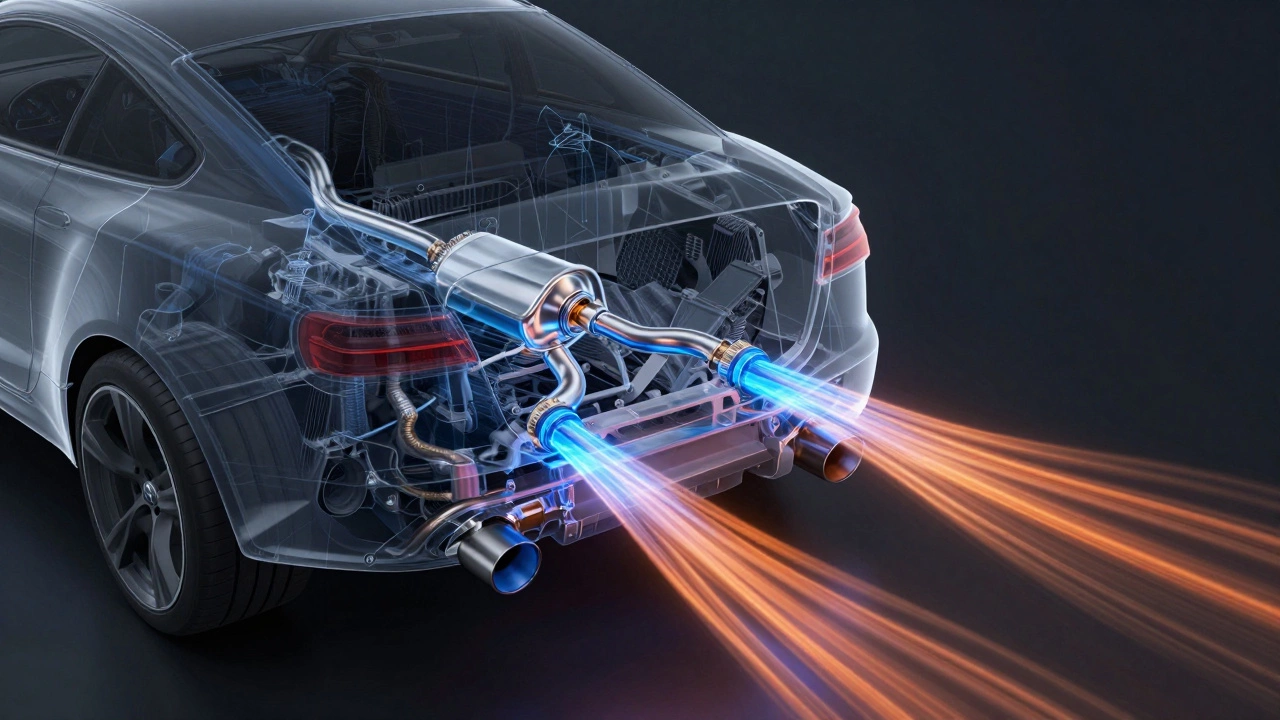
To understand if an upgrade is worth it, you have to understand what the factory system is doing. Your car comes with a stock exhaust designed by engineers to balance three things: emissions laws, fuel economy, and noise comfort. They use restrictive components to keep the car quiet and the air clean. When you upgrade, you're essentially removing those bottlenecks.
The most restrictive part of any system is usually the Catalytic Converter. This device uses a ceramic honeycomb structure to burn off pollutants. While essential for the planet, it's a narrow straw for your engine's breath. If you replace this with a high-flow version or a "test pipe," the engine can push air out faster, which theoretically lets it pull more air in during the intake stroke.
Then you have the Muffler. This is basically a series of chambers designed to cancel out sound waves. Upgrading this doesn't usually add power, but it changes the "voice" of your car. If you want a deep rumble or a high-pitched scream, this is where the magic happens.
The Different Levels of Upgrades
Not all exhaust mods are created equal. Depending on how much of the system you replace, your results will vary wildly. Most people start with a "cat-back" because it's the easiest to install and doesn't mess with your engine's computer sensors.
| Type | What's Replaced | Power Gain | Sound Change | Complexity |
|---|---|---|---|---|
| Cat-Back | Everything after the catalytic converter | Low (1-5 hp) | Significant | Easy |
| Cat-Delete / High-Flow Cat | The catalytic converter | Medium (5-15 hp) | Very High | Moderate |
| Headers / Manifolds | The pipes connecting engine to exhaust | High (10-25 hp) | Moderate | Hard |
| Full System | Everything from the engine back | Maximum | Extreme | Hard |
The Horsepower Myth vs. Reality
Let's be honest: on a completely stock, naturally aspirated 4-cylinder car, a cat-back exhaust will not make you feel a difference in your seat. You might see a 2 or 3 horsepower gain on a dyno, but in the real world, that's just rounding error. If you're chasing raw speed, spending $800 on a pipe is a bad investment.
However, if you have a Turbocharger or a Supercharger, the story changes. Forced induction engines move a massive volume of air. A restrictive stock exhaust can actually hold back a turbo, causing higher exhaust gas temperatures and limiting the boost the turbo can create. In these cases, a 3-inch mandrel-bent pipe can lead to tangible gains in torque and top-end power.
A great example is the Subaru WRX or the Mitsubishi Evo. These cars often have restrictive factory mid-pipes. Swapping to a high-flow mid-pipe often unlocks a noticeable jump in mid-range acceleration because the turbo can spool up faster without fighting a wall of backpressure.
The Sound Factor: More Than Just Noise
For many, the "worth it" factor is entirely about the emotion. A car that sounds powerful feels more powerful, even if the speedometer says otherwise. But there's a trap here: Drone. Drone is that oppressive, humming sound that happens at a specific RPM (usually around 2,000 to 3,000) during highway cruising. It can turn a 20-minute commute into a headache-inducing nightmare.
To avoid this, look for systems with Resonators. These are smaller chambers designed to cancel out specific frequencies. If you go "straight pipe" (no muffler, no resonator), you'll be loud, but you'll likely experience severe drone. If you value your sanity on long trips, keep at least one resonator in the mix.
The Hidden Costs and Legal Headaches
Before you pull the trigger, consider the EPA and your local laws. Removing a catalytic converter is a federal crime in the US and will make your car fail an emissions test in any state with smog checks. You'll get a "Check Engine Light" (CEL) because the oxygen sensors will detect that the catalyst is missing.
To fix the CEL, you'll need an ECU tune or "O2 spacers," which are essentially tricks to fool the computer. This adds another layer of cost and complexity to the build. If you live in a strict area, sticking to a high-flow catalytic converter is a much smarter move than a full delete.

Common Pitfalls to Avoid
Many beginners make the mistake of buying the cheapest system they find on eBay or Amazon. These are often made of thin, aluminized steel that will rust through in two winters if you live in the "salt belt." If you're spending the money, go for T304 Stainless Steel. It's more expensive, but it won't rot away.
Another mistake is ignoring the diameter of the pipe. Bigger isn't always better. If you put a 4-inch pipe on a tiny engine, you'll lose exhaust velocity. When the air slows down too much, it can actually hinder the engine's ability to scavenge spent gases from the cylinder, potentially *reducing* your low-end torque. Match the pipe size to your engine's displacement and power goals.
Final Decision Matrix
If you're still on the fence, ask yourself what your primary goal is. If you want the car to feel like a different beast every time you cold-start it in the morning, go for it. The psychological boost of a great-sounding engine is a huge part of the ownership experience.
But if you're expecting a 0-60 time drop of a full second, you're looking at the wrong part. To get real power, you need a combination of intake, exhaust, and a Tuning software update to tell the engine how to use that extra airflow. An exhaust is just one piece of the puzzle, not the whole solution.
Will an exhaust upgrade ruin my fuel economy?
Generally, the effect is negligible. In some cases, reducing backpressure can slightly improve efficiency because the engine doesn't have to work as hard to push air out. However, most people with loud exhausts tend to drive more aggressively, which is what actually kills the MPG.
Do I need to retune my car after installing a cat-back?
For a simple cat-back system, you typically don't need a tune. The sensors that manage fuel and timing are located before the cat-back section. However, if you change the headers or remove the catalytic converter, a tune is highly recommended to prevent the engine from running too lean or throwing error codes.
What is the difference between a muffler delete and an aftermarket muffler?
A muffler delete is simply removing the muffler and replacing it with a straight pipe. This is the loudest option and often leads to a "raspy" sound and high drone. An aftermarket muffler is engineered to give you a specific tone (deep, crisp, or aggressive) while still controlling the volume to some degree.
Will a louder exhaust attract more police attention?
Yes, it can. Many cities have noise ordinances. If your car is excessively loud, you're more likely to be pulled over for a "fix-it ticket." To avoid this, choose a system with a variable valve exhaust that allows you to switch between quiet and loud modes.
Can I just put a tip on my stock exhaust to make it look better?
Absolutely. If you only care about the aesthetics and not the sound or performance, a polished exhaust tip is a cheap and effective way to upgrade the look of the rear end without spending hundreds on a full system.
Next Steps for Your Build
If you've decided to go forward, start by researching the specific materials used in the kits you're eyeing. Look for "mandrel-bent" pipes rather than "stamped" pipes; mandrel-bent pipes maintain a constant diameter throughout the curve, which ensures smoother airflow.
For those on a budget, consider a "muffler shop」 custom build. Instead of buying a brand-name kit, you can have a professional shop fabricate a system using high-quality parts. This often allows you to pick the exact muffler brand (like MagnaFlow or Vibrant) and ensures a perfect fit for your specific vehicle setup.