Custom Exhaust Cost Estimator
Estimated Cost
Ever heard someone say their car sounds like a jet because they got a custom exhaust? It’s not magic. It’s metal, welding, and decades of tuning know-how. But can any shop just make one? The answer isn’t yes or no-it’s maybe, and here’s why.
Not All Shops Can Build a Custom Exhaust
A regular mechanic who changes oil and replaces brake pads? They won’t cut it. Building a custom exhaust isn’t about swapping out a stock pipe. It’s engineering. You need someone who understands flow dynamics, heat resistance, vibration, and how sound travels through steel. Most shops don’t have the tools-or the training-to do it right.
Think of it like baking bread. Anyone can buy a loaf. But making sourdough from scratch? That takes time, experience, and the right oven. Same with exhausts. A custom system isn’t just a longer or louder pipe. It’s a tuned component that works with your engine’s breathing, timing, and power curve.
What Makes a Shop Qualified?
Look for shops that specialize in exhaust fabrication, not just sales. These are the places with CNC benders, tube cutters, TIG welders, and dyno access. They don’t just install pre-made kits-they design from scratch. In Adelaide, you’ll find a handful of these shops tucked into industrial zones in Wingfield or Port Adelaide. They’ve built systems for drag racers, street machines, and even classic Holdens that haven’t been made since the ’80s.
Ask them: “Have you built an exhaust for my exact car model?” If they say “We do them all,” that’s a red flag. Every engine is different. A 2.0L turbo four needs a different flow path than a 5.7L V8. A shop that’s built ten Subaru WRX systems might not know how to handle a Nissan RB26.
How Custom Exhausts Actually Work
A custom exhaust isn’t just about noise. It’s about efficiency. Stock exhausts are designed for cost, emissions, and quiet operation-not performance. A good custom system reduces backpressure, which lets your engine breathe easier. That means more power, better throttle response, and sometimes even better fuel economy.
Here’s how it breaks down:
- Header design: The first section that collects exhaust gases from each cylinder. Equal-length headers balance pressure waves, which boosts torque.
- Pipe diameter: Too small? You choke the engine. Too big? You lose low-end power. Most street cars perform best with 2.25” to 3” tubing.
- Muffler type: Straight-through, chambered, or glasspack? Each changes sound and flow differently.
- Material: Mild steel rusts. Stainless steel lasts. Aluminized is a middle ground.
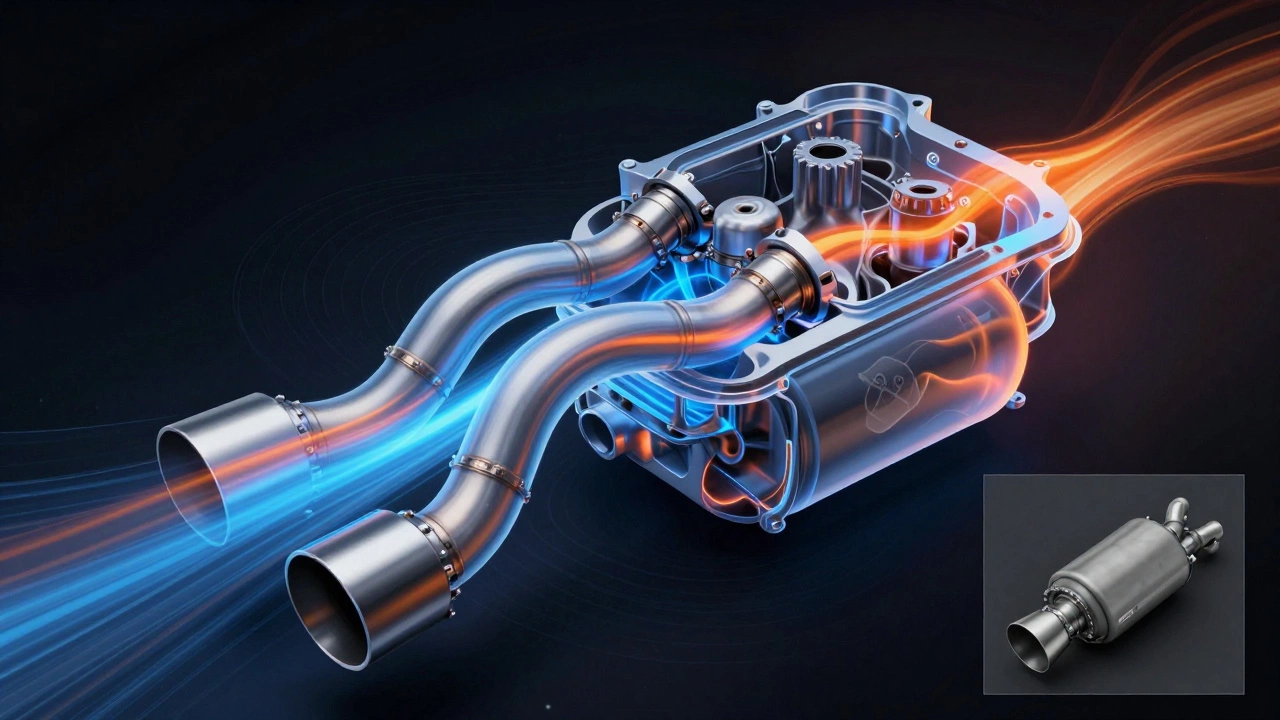
Good fabricators use software to simulate exhaust flow before they cut a single piece of pipe. They know that a 15-degree bend creates less turbulence than a 90-degree one. They don’t guess-they calculate.
What You Get (and Don’t Get) With Custom
When you go custom, you’re not just buying a louder exhaust. You’re buying:
- Exactly the sound you want-from a deep rumble to a high-pitched scream
- Fitment that matches your car’s exact dimensions, even if it’s lowered or modified
- Weight savings-some custom systems are 30% lighter than stock
- Performance gains: 5-15 horsepower, depending on the engine and tuning
What you don’t get:
- A guaranteed power increase if your engine isn’t tuned
- A system that passes emissions if you live in a strict region (like Victoria or NSW)
- Instant results without proper installation
One guy in Adelaide had a 2010 Ford Falcon with a custom exhaust installed by a shop that skipped the mid-pipe. The system rattled, leaked, and made his car fail its roadworthy. He spent $1,200 to fix it. The right shop would’ve done it right the first time.
Costs and Timeframes
A custom exhaust isn’t cheap. You’re paying for labor, materials, and expertise. Here’s what you can expect in 2026:
- Basic custom system (header to tailpipe, stainless steel, no resonator): $1,800-$2,500
- Full race system (titanium tips, dual outlets, custom tuning): $3,500-$6,000
- Time to build: 2-6 weeks, depending on shop workload and complexity
Compare that to a $800 bolt-on kit from eBay. The kit installs in an hour. But it’s made in a factory overseas, fits poorly, and sounds like a lawnmower with a bad muffler. You get what you pay for.

What to Ask Before You Commit
Don’t hand over cash without asking these five questions:
- “Can I see examples of past builds for my car model?”
- “Do you use CAD or flow simulation software?”
- “Will you dyno-test the system after installation?”
- “What warranty do you offer on welds and materials?”
- “Will this system pass a roadworthy inspection in South Australia?”
Any shop that hesitates on the last one shouldn’t be trusted. In Australia, modified exhausts must meet ADR 27A standards. Loud doesn’t mean legal. A good fabricator will design around those rules-not ignore them.
When Not to Go Custom
Custom exhausts aren’t for everyone. If you’re:
- On a tight budget under $1,500
- Planning to sell your car in under a year
- Unwilling to get an ECU tune after installation
- Living in a noise-restricted suburb
Then a high-quality aftermarket kit is your better option. Brands like Borla, Akrapovič, or Milltek offer great sound and fitment without the wait and cost of custom fabrication.
The Real Benefit: Ownership
The best part of a custom exhaust isn’t the horsepower. It’s the fact that it’s yours. No one else has the same setup. You chose the sound, the finish, the shape. You watched it being built. You know exactly what’s inside it.
That’s why people in Adelaide drive past their old street corners just to hear their exhaust echo off the brick walls. It’s not about showing off. It’s about pride in something made for them, by someone who cares.
So yes-a shop can make a custom exhaust. But only the right one. And that’s the difference between a loud car… and a great one.
Can any mechanic install a custom exhaust?
No. Installing a custom exhaust requires more than basic tools-it needs experience with alignment, welding, and vibration control. Most general mechanics lack the equipment and expertise. Look for a shop that specializes in exhaust fabrication, not just general repairs.
How long does it take to build a custom exhaust?
It usually takes 2 to 6 weeks. Simple systems with standard parts can be done in 2 weeks. Complex builds with custom headers, dual outlets, or titanium components may take 4-6 weeks, especially if the shop is busy. Always ask for a timeline before paying a deposit.
Will a custom exhaust pass a roadworthy in Australia?
Yes, if it’s built to meet ADR 27A standards. The system must not produce excessive noise, must not leak, and must retain emissions controls (unless the vehicle is exempt). Reputable fabricators design systems to pass inspections. Avoid shops that say “it’ll be fine” without showing proof of compliance.
Is stainless steel worth the extra cost?
Yes, if you plan to keep the car for more than 3 years. Stainless steel resists rust and corrosion, lasts 2-3 times longer than mild steel, and holds its finish better. Mild steel systems can rust through in 2-3 years, especially in coastal areas like Adelaide. The upfront cost is higher, but you save money long-term.
Do I need a tune after installing a custom exhaust?
Not always, but you’ll get better results if you do. A custom exhaust changes how your engine breathes. Without a tune, the ECU might not adjust fuel and timing correctly, which can hurt performance or cause check engine lights. For turbocharged or high-performance engines, a tune is strongly recommended.
Can I get a custom exhaust for an older car?
Absolutely. Many fabrication shops specialize in classic cars-Holden Commodores, Ford Falcons, Toyota Celicas from the ’80s and ’90s. They use templates, measurements, and even 3D scanning to recreate systems for cars that no longer have factory parts. Just make sure the shop has experience with your specific model.