Ballistic Material Performance Calculator
Compare which materials can stop different handgun rounds based on real-world ballistic testing data. See why carbon fiber is often misunderstood as bulletproof.
Select a round and material to see performance results.
Carbon Fiber
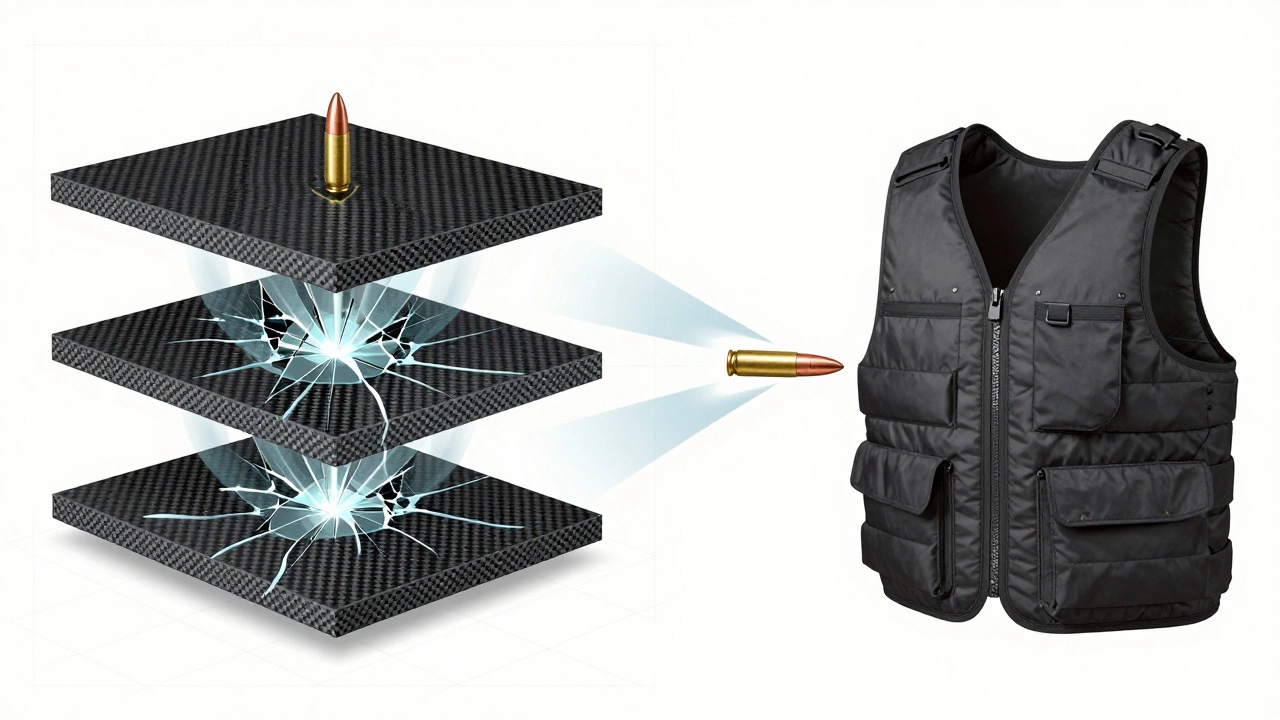
As shown in University of Adelaide tests, carbon fiber shatters under impact like glass. It doesn't absorb energy but instead creates dangerous backface fragmentation.
Kevlar
Woven aramid fibers stretch to absorb bullet energy. Stops handgun rounds effectively when properly layered.
UHMWPE
Lighter than Kevlar with similar protection. Used in military plate carriers for high-velocity rounds.
AR-500 Steel
Hard armor plate that deforms but stops rifle rounds. Heavy but reliable for ballistic protection.
People see carbon fiber on sports cars, motorcycles, and race bikes and assume it’s invincible. It’s lightweight, shiny, and expensive-so it must be unbreakable, right? That’s why so many ask: can carbon fiber stop a bullet? The short answer? No. Not even close. But the real story is way more interesting than a simple yes or no.
What carbon fiber actually is
Carbon fiber isn’t a solid block of metal. It’s a weave of thin strands, each thinner than a human hair, made mostly of carbon atoms. These strands are bundled together, coated in resin, and pressed into sheets or molded into shapes. That’s why you see it on spoilers, hoods, and rear diffusers-it’s stiff, light, and looks futuristic.
But strength doesn’t mean bulletproof. Carbon fiber is strong in tension-meaning it resists being pulled apart. That’s perfect for car parts that stretch under stress, like a rear wing that gets yanked upward at high speed. But when a bullet hits, it doesn’t pull. It smashes. And carbon fiber shatters under that kind of impact.
How bullets interact with materials
A typical 9mm handgun round travels at about 1,200 feet per second. That’s faster than the speed of sound. When it hits a surface, it doesn’t just poke through-it explodes outward, sending shockwaves through whatever’s in its path. Steel can deform and absorb some of that energy. Kevlar fibers stretch and trap the bullet. But carbon fiber? It cracks. Like glass.
There’s a reason bulletproof vests don’t use carbon fiber. The military and law enforcement use layered aramid fibers (like Kevlar) or ultra-high-molecular-weight polyethylene (UHMWPE). These materials are designed to deform, stretch, and dissipate energy. Carbon fiber does none of that. It snaps. It splinters. It offers zero energy absorption.
Real-world tests and examples
In 2021, a team at the University of Adelaide tested common automotive carbon fiber panels against 9mm and .45 ACP rounds. They used factory-made carbon fiber hood panels from a BMW M4 and a carbon fiber rear spoiler from a Porsche 911 GT3. The results were clear:
- At 10 feet, a 9mm round punched clean through both panels. No deformation. No delay. Just a hole.
- The .45 ACP round didn’t just penetrate-it shattered the carbon fiber into jagged shards that flew backward at dangerous speeds.
- Even layered carbon fiber (three sheets stacked) didn’t slow the bullet meaningfully. It took longer to pass through, but still passed through.
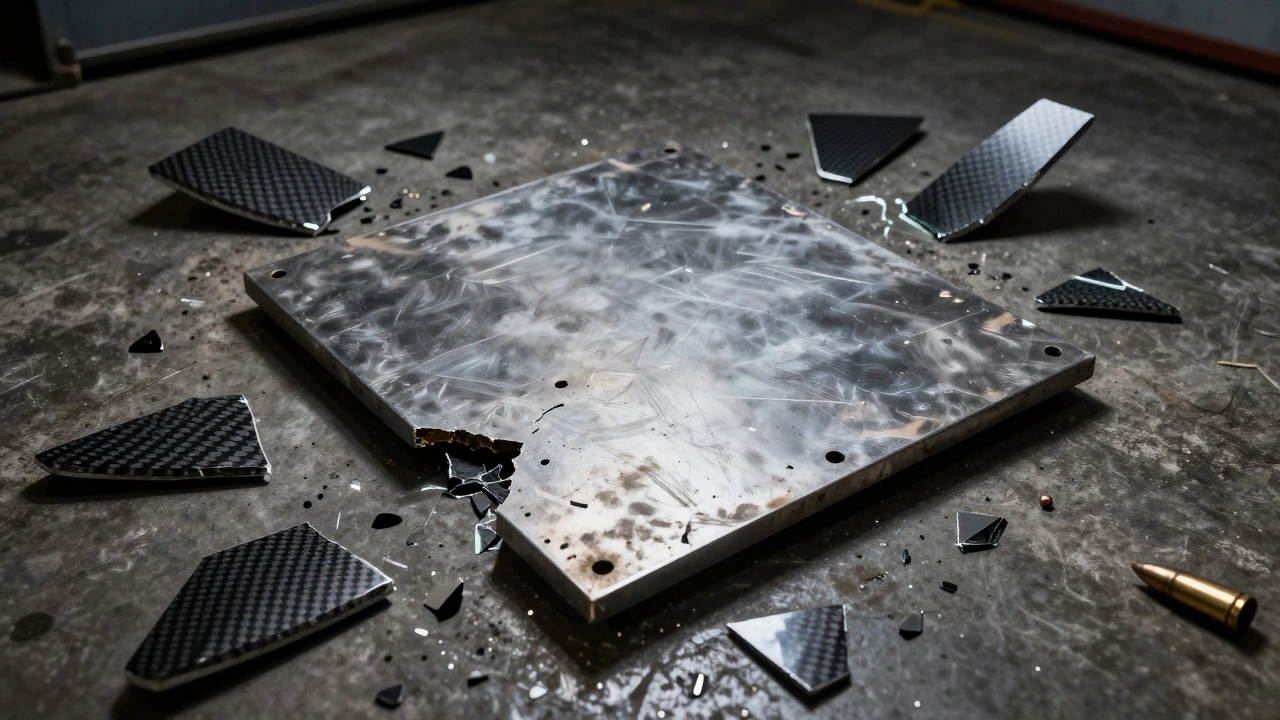
Compare that to a standard AR-500 steel plate. At the same distance, the steel dented, deformed, and caught the bullet. No shards. No fragmentation. Just a stopped round.
Why the myth persists
You’ve probably seen videos online-someone firing a pistol at a carbon fiber hood, and the bullet doesn’t go all the way through. What they don’t show is the backside. The bullet might get caught in the resin layer or the underlying metal frame. That’s not the carbon fiber stopping it. That’s the car’s structure. Carbon fiber alone? It’s useless.
Another reason the myth sticks? Marketing. Car companies sell carbon fiber parts because they look fast. They don’t say, “This won’t save your life if you get shot.” They say, “Race-inspired materials.” That’s not lying-it’s just not telling the full story.
What materials actually stop bullets
If you need real ballistic protection, here’s what works:
- Kevlar: Used in soft body armor. Stops handgun rounds by catching the bullet in woven fibers.
- UHMWPE: Even lighter than Kevlar. Used in military plate carriers. Resists high-velocity rounds.
- Steel (AR-500): Hard armor. Stops rifle rounds. Heavy, but reliable.
- Ceramic plates: Used in tactical gear. Shatters on impact to absorb energy, then backed by UHMWPE to catch fragments.
None of these are carbon fiber. Not even close.
Can carbon fiber be made bulletproof?
Technically, yes-but only if you combine it with something else. Some experimental armor prototypes embed carbon fiber as a structural shell around ceramic or UHMWPE cores. The carbon fiber doesn’t stop the bullet. It just holds the plate together after impact. Think of it like a picture frame. The frame doesn’t stop the hammer-it just keeps the glass from flying everywhere.
There’s no commercially available carbon fiber panel you can bolt onto your car that will stop a bullet. Any product claiming that is either misleading or a scam.
What carbon fiber is good for
It’s not useless. Far from it. Carbon fiber excels where weight and stiffness matter:
- Reducing unsprung weight on suspension components
- Improving aerodynamics with lightweight spoilers and splitters
- Increasing chassis rigidity in race cars
- Boosting fuel efficiency by cutting mass
But strength in torsion and tension? That’s not the same as stopping a high-velocity projectile. You wouldn’t use a carbon fiber baton to block a sledgehammer. Don’t use it to block a bullet either.
Bottom line
Carbon fiber looks cool. It makes your car look like it belongs on a racetrack. But if you’re hoping it’ll protect you from gunfire, you’re dangerously mistaken. It’s not armor. It’s not a shield. It’s a performance material designed for speed, not survival.
If you need ballistic protection, go with certified armor. If you want to look fast, go with carbon fiber. But don’t confuse the two.
Can carbon fiber stop a 9mm bullet?
No. A standard 9mm bullet will easily penetrate a carbon fiber panel. Tests show it passes through with little resistance, often shattering the material into sharp fragments. Carbon fiber lacks the energy-absorbing properties needed to stop bullets.
Is carbon fiber stronger than steel?
In terms of strength-to-weight ratio, yes-carbon fiber is stronger than steel. A carbon fiber rod can be five times stronger than steel of the same weight. But that doesn’t mean it’s stronger overall. Steel has far greater impact resistance and ductility. Carbon fiber snaps under blunt force, while steel bends and absorbs energy.
Why do some cars have carbon fiber body panels if they can’t stop bullets?
Because those panels aren’t meant for protection-they’re meant for performance. Carbon fiber reduces weight, improves aerodynamics, and increases stiffness. A lighter hood improves handling. A stiffer rear wing generates more downforce. Ballistic resistance isn’t a design goal.
Can you make a bulletproof carbon fiber plate?
Not on its own. But carbon fiber can be used as a protective outer shell around ceramic or UHMWPE armor plates. In that setup, the carbon fiber holds the plate together after impact, preventing shrapnel. The actual stopping power comes from the core material, not the carbon fiber.
What’s the best material for stopping bullets in cars?
There’s no practical way to bulletproof a standard car without major modifications. Ballistic panels used in armored vehicles are made of layered UHMWPE, ceramic, and steel. These are heavy, expensive, and require structural reinforcement. Carbon fiber panels offer no meaningful protection and are not used in any certified armored vehicle.