Ever heard a car roll past with a sound like a jet engine and wondered if the driver’s going to get pulled over? You’re not alone. In Australia, especially in places like Adelaide where quiet streets and residential zones matter, a too-loud exhaust isn’t just annoying-it can get you fined, forced to fix it, or even have your car impounded. So yes, cops can stop you if your exhaust is too loud. And they will.
What Counts as "Too Loud"?
There’s no single decibel number written in stone that says "this is illegal." But in Australia, the law doesn’t need one. The Road Traffic Act 1961 (SA) and the National Heavy Vehicle Law both say your vehicle must not produce noise that is "excessive" or "unreasonable." That’s it. No number. No exception for "it’s just a custom exhaust."
What does "excessive" mean in practice? If you’re driving past a house at 8 a.m. and the windows rattle, or if a pedestrian has to shout to be heard next to your car, you’re already over the line. Police don’t need a decibel meter to decide-you’re loud enough if a reasonable person would think it’s too much.
Some states have guidelines: South Australia recommends aftermarket exhausts stay under 90 decibels at 20 meters. But that’s not a legal limit-it’s a benchmark. If you’re running a straight pipe with no muffler, you’re almost certainly over. Even a "race-tuned" system that sounds cool on the track will get flagged on public roads.
How Do Police Know It’s Too Loud?
You’d think cops need fancy gear to prove you’re too loud. They don’t. Most of the time, they don’t even use a meter.
Officers are trained to recognize abnormal noise. If your car sounds like it’s missing half its engine, or if you’re revving it at a red light just to show off, they’ll pull you over. They’ll ask you to idle or rev the engine while they listen. If it’s clearly louder than a stock vehicle, that’s enough for them to act.
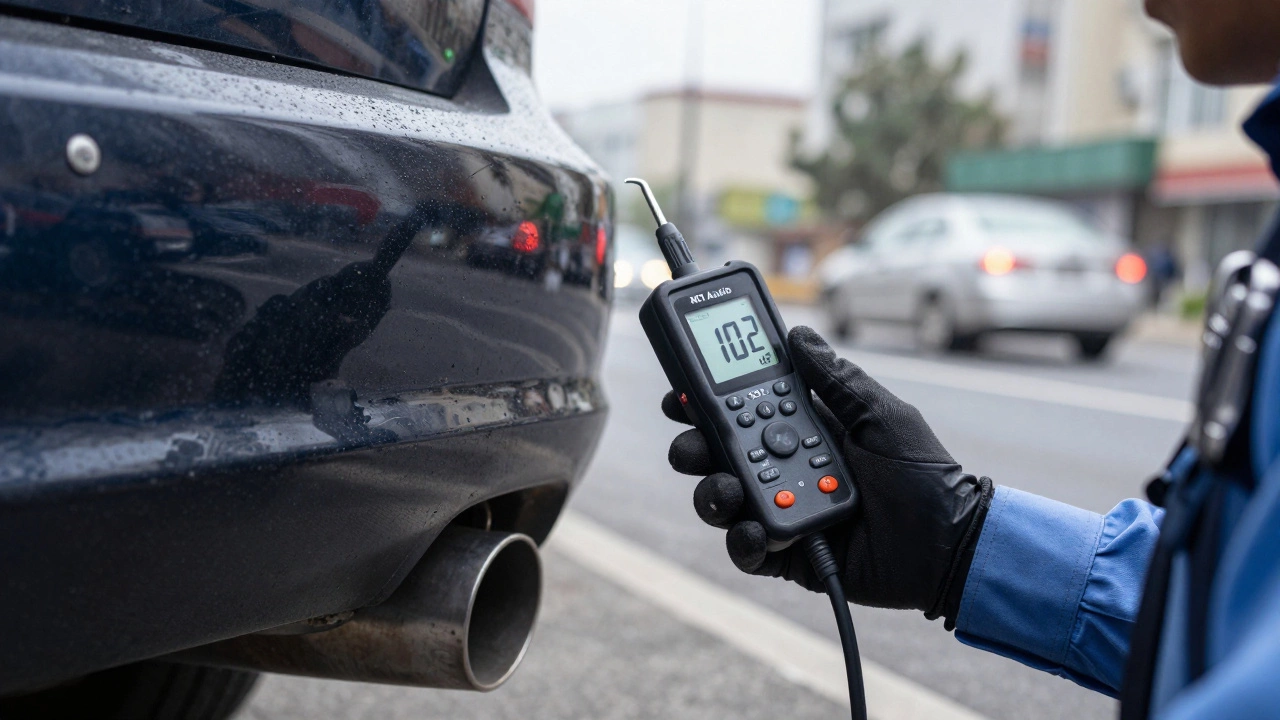
Some police forces carry handheld noise meters-like the NTi Audio XL2 or similar-but even if they don’t, your exhaust’s sound alone is often enough evidence. A witness, a neighbor’s complaint, or even a dashcam video from another driver can trigger an investigation. In Adelaide, traffic officers have been known to stop cars just because they heard the noise from a block away.
What Happens When You Get Stopped?
Getting pulled over for a loud exhaust doesn’t always mean a fine. But it almost always means trouble.
- On-the-spot fine: In South Australia, you can be issued a $300-$500 penalty for a noise violation under the Road Traffic (Vehicles) Regulations 2022. This is common for obvious modifications like removed mufflers or open headers.
- Prohibition notice: The officer may issue a notice saying your vehicle is unsafe or non-compliant. You’ll have 14 days to fix it. If you don’t, your registration can be suspended.
- Vehicle impound: If you’re caught repeatedly, or if the noise is extreme (think 110+ decibels), your car can be seized. This is rare but does happen, especially if you’ve been warned before.
- Re-inspection required: You might be told to take your car to an authorized inspection station to prove the exhaust meets standards. That costs $80-$150 on top of any fines.
And here’s the kicker: if you get into an accident while driving with an illegal exhaust, your insurance company can deny your claim. They’ll say you were operating an unroadworthy vehicle. That’s not a rumor-it’s happened in multiple court cases across Australia.
What Exhausts Are Legal?
Not all aftermarket exhausts are illegal. Many are designed to meet Australian Design Rules (ADR) and carry certification. Look for these signs:
- ADR-compliant: The exhaust should have a label or documentation proving it meets ADR 43/04 for noise.
- Manufacturer certification: Brands like Akrapovič, Milltek, or Catback Systems often test their systems for compliance. Ask for proof.
- Retains catalytic converter: Removing the cat is illegal everywhere in Australia, regardless of noise.
- Has baffles or resonators: A quiet aftermarket system still has internal sound-dampening parts. If it looks like a straight pipe with no internal structure, it’s not street legal.
Some shops in Adelaide sell "track-only" exhausts and tell you to "just use it on weekends." That’s not a defense. The law doesn’t care if you only drive it on Sundays. If it’s on the road, it must comply.
What About Modified Cars with "Quiet" Tuning?
Here’s a myth: "If I tune it to be quiet, it’s fine."
Some people install high-flow cats, performance mufflers, or ECU tunes that reduce drone at cruising speeds-but still let the engine scream under acceleration. That’s still a problem. The law looks at the maximum noise level your system produces, not the average. If your car hits 105 decibels when you floor it on the highway, you’re breaking the law-even if it’s quiet at 60 km/h.
There’s no such thing as a "stealth loud" exhaust that’s legal on public roads. If it sounds like a sports car on a racetrack, it’s probably not street legal.
What Should You Do?
If you’re thinking of installing a new exhaust:
- Ask the installer for ADR 43/04 certification. If they can’t provide it, walk away.
- Don’t remove the catalytic converter. Ever. It’s illegal and increases noise.
- Test the system on a quiet street before driving it far. If neighbors complain, it’s too loud.
- If you already have a loud system, get it checked by a certified mechanic. Many offer noise testing for under $50.
- When in doubt, stick with OEM or certified aftermarket systems. They’re safer, legal, and often better built.
And if you’re already being pulled over? Don’t argue. Stay calm. Ask for the specific regulation you’re violating. Most officers will explain it. Fighting it in court is expensive, and you’ll likely lose. The law is clear: if it’s too loud, it’s illegal.
Real-World Example: Adelaide Case
In late 2025, a 2021 Subaru WRX with a custom cat-back exhaust and no muffler was stopped by Adelaide police during a routine patrol. The driver claimed he "bought it online and didn’t know it was illegal." Police measured the noise at 102 decibels at 20 meters-well above the recommended 90. He was fined $470, had his registration suspended for 30 days, and was ordered to install a certified system within 14 days. He didn’t appeal. He said he didn’t want to risk losing his car.
That’s not an outlier. It’s standard procedure.
Bottom Line
Custom exhausts are fun. They make your car sound amazing. But if you’re driving on public roads in Australia, your exhaust must meet legal noise standards. Cops don’t need a decibel meter to know when something’s too loud. They rely on training, experience, and public complaints. And they will stop you.
There’s no gray area: if your exhaust sounds like it belongs on a drag strip, it’s not legal on the street. Don’t gamble with fines, registration suspension, or insurance denial. Install something that’s certified. Or stick with stock. Your wallet-and your car-will thank you.
Can police stop me just because my exhaust is loud, even if I’m not speeding?
Yes. In Australia, noise violations are standalone offenses under road traffic laws. Police don’t need to catch you speeding or running a red light to pull you over. If your exhaust is deemed excessive, they can stop you on the spot based on noise alone.
Is there a legal decibel limit for car exhausts in Australia?
There’s no universal number written into law, but ADR 43/04 sets a recommended maximum of 90 decibels at 20 meters for passenger vehicles. Police use this as a benchmark. If your exhaust exceeds this, especially if it’s clearly louder than a stock vehicle, you’re at risk of being fined or issued a prohibition notice.
Can I get away with a loud exhaust if I only drive it on weekends?
No. The law applies whenever your vehicle is on a public road, regardless of the day or time. Whether it’s 7 a.m. on a Tuesday or 2 a.m. on a Saturday, if your exhaust is too loud, it’s illegal. Police don’t make exceptions based on usage patterns.
What if I bought the exhaust from a shop that said it was legal?
You’re still responsible. Shops can give bad advice, but the law holds the vehicle owner accountable. If your exhaust is non-compliant, you’ll be fined regardless of who sold it to you. Always ask for ADR 43/04 certification before buying.
Will my insurance cover me if I have a loud exhaust and get in an accident?
Possibly not. Insurance companies can deny claims if your vehicle is deemed unroadworthy. A loud, non-compliant exhaust may be considered a modification that compromises safety or compliance. If you’re found to be in breach of road regulations, your insurer may refuse to pay out.