Alloy Wheel Balance & Cost Calculator
Symptoms & Configuration
Select any issues you are experiencing with your vehicle.
Diagnosis & Cost Estimate
Cost Breakdown:
- Base Service Fee: $0.00
- Weight/Material Surcharge: $0.00
- Premium Tech Fee (if applicable): $0.00
- Total Estimated Cost: $0.00
Recommendation:
Please select your symptoms and configuration to receive a personalized recommendation based on industry standards.
You install a fresh set of alloy wheels is lightweight automotive rims made from aluminum or magnesium alloys that improve vehicle aesthetics and performance. on your car. They look sharp. You take them for a spin at 100 km/h, and suddenly the steering wheel feels like it’s trying to dance its way out of your hands. That jittery sensation isn’t just annoying; it’s a warning sign. It usually means your wheels aren’t balanced.
The short answer is yes, alloy wheels absolutely need to be balanced. In fact, they often require more precise balancing than standard steel wheels because of how they are manufactured. If you skip this step, you risk uneven tire wear, suspension damage, and a ride quality that feels cheap despite your expensive upgrade. Let’s break down why this happens and what you can do about it.
Why Balance Matters More Than Ever
Wheel balancing isn’t just a suggestion from the service manual; it’s physics. A wheel and tire assembly is supposed to rotate perfectly evenly around its center point. If there’s even a small weight discrepancy-say, an extra gram on one side-the centrifugal force throws things off as speed increases. This creates a harmonic vibration that travels through the suspension and into the cabin.
For steel wheels is traditional heavy-duty rims made from stamped steel that offer durability but lack aesthetic appeal compared to alloys., minor imbalances are less noticeable because the metal is thicker and heavier, absorbing some of the irregularity. But alloys are lighter and thinner. They don’t have that mass buffer. Any tiny defect in the casting process or any slight variation in tire thickness becomes immediately apparent at highway speeds.
Think of it like a washing machine. If you put one heavy towel in, it spins wildly. If you distribute the load evenly, it glides smoothly. Your tires and wheels are no different. Without proper balance, you’re essentially running your car’s rotating components with an uneven load.
The Manufacturing Reality: Cast vs. Forged
Not all alloy wheels are created equal, and their manufacturing method plays a huge role in how well they balance out of the box. Most aftermarket alloys are cast. This involves pouring molten aluminum into a mold. While cost-effective, casting can leave microscopic air pockets or density variations within the metal structure. These imperfections mean the wheel might not be perfectly symmetrical by weight.
Forged alloy wheels is high-performance rims created by compressing solid blocks of aluminum under extreme pressure for superior strength and precision. are different. Because they are formed under immense pressure, the metal grain structure is tighter and more uniform. They tend to come closer to perfect balance straight from the factory. However, even forged wheels need final balancing once mounted with a tire because the tire itself introduces variables.
Tires aren’t perfectly round either. During manufacturing, the belt package inside the tire might shift slightly, creating a "heavy spot." When you combine a potentially imperfect wheel with an imperfect tire, the odds of having a perfectly balanced assembly without adding weights are near zero.
Static vs. Dynamic Balancing: What’s the Difference?
If you’ve ever watched a mechanic mount a tire, you’ve seen two types of machines. Understanding the difference helps you know what you’re paying for.
Static balancing corrects imbalance on a single plane. Imagine the wheel sitting still on a flat surface. If it rolls to one side, that side is heavier. Static balancing adds weight to the opposite side to stop it from rolling. This works for older vehicles or slower cars, but it doesn’t account for forces that happen while the wheel is spinning.
Dynamic balancing is the standard for modern cars. It measures imbalance on two planes: the inner barrel and the outer lip of the wheel. As the wheel spins, it can wobble side-to-side (lateral imbalance) as well as up-and-down (vertical imbalance). Dynamic balancing places weights on both the inside and outside of the rim to cancel out these wobbling forces. For alloy wheels, especially wider ones, dynamic balancing is non-negotiable.
| Feature | Static Balancing | Dynamic Balancing |
|---|---|---|
| Planes Corrected | One (Vertical) | Two (Vertical & Lateral) |
| Best For | Older vehicles, narrow tires | Modern cars, wide alloy wheels |
| Vibration Control | Basic | High-speed stability |
| Weight Placement | Outer lip only | Inner barrel and outer lip |
Signs Your Alloys Are Out of Balance
You don’t need a degree in engineering to tell if your wheels are unbalanced. Your body will feel it long before your eyes see it. Here are the most common symptoms:
- Steering Wheel Shake: If the vibration is primarily felt in the steering wheel, the issue is likely with the front wheels. This usually starts between 80-100 km/h and gets worse as you accelerate.
- Seat Vibration: If the whole car shudders, or you feel the buzz in your seat, the rear wheels are probably out of balance.
- Uneven Tire Wear: Check your tires periodically. Unbalanced wheels cause cupping or scalloping patterns on the tread. Instead of a smooth surface, you’ll see dips and peaks across the width of the tire.
- Noise: An unbalanced tire creates a rhythmic humming or thumping sound that increases with speed.
Ignoring these signs doesn’t make them go away. Over time, the constant shaking stresses your wheel bearings, struts, and tie rods. Repairing suspension components costs significantly more than a quick balance job.
The Weight Dilemma: Clips vs. Adhesive
Here’s where many alloy wheel owners get picky. Traditional lead weights are clipped onto the edge of the rim. On steel wheels, nobody cares. On polished or painted alloys, those clips can scratch the finish, trap dirt, and look ugly. Some enthusiasts refuse to drive with visible clips.
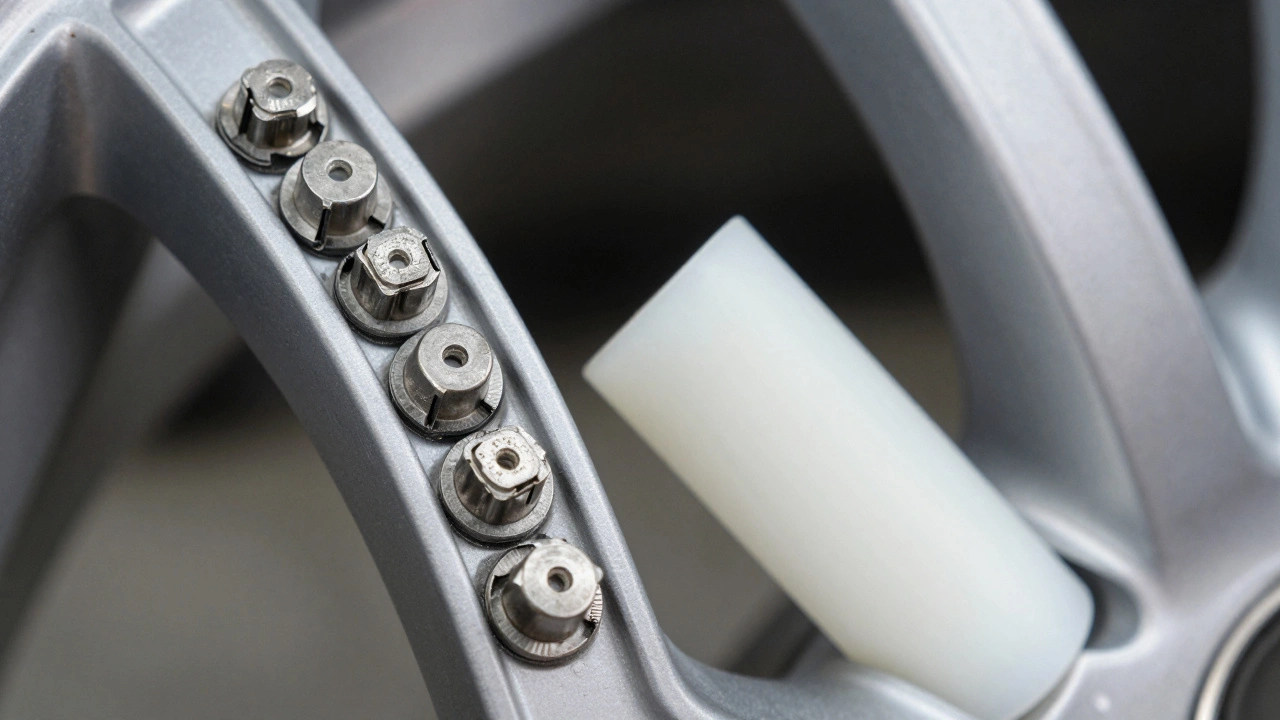
This is where adhesive wheel weights is tape-backed balancing weights applied to the inner barrel of the wheel to maintain aesthetic cleanliness and prevent corrosion. come in. These are glued to the inside face of the rim. They are invisible from the outside and protect the alloy finish from stone chips and corrosion. Most professional shops use adhesive weights for alloys as a standard practice.
Another option is magnetic wheel weights is temporary balancing aids that stick to the wheel via magnetism but are generally discouraged for permanent use due to reliability issues. While convenient, mechanics often advise against them for daily drivers. They can fall off in hot weather or get dislodged by road debris, leading to sudden imbalance. Stick to adhesive or high-quality clip-on weights designed for alloys.

When Should You Balance Your Wheels?
Balancing isn’t a one-time event. It’s part of routine maintenance. You should consider balancing in these scenarios:
- New Tires: Every time you mount new tires, the assembly changes. Even if you reuse the old wheels, the new tire has a different weight distribution.
- After Impact: Hit a pothole hard? Curbs happen. A bent rim or a shifted tire bead can throw off balance instantly.
- Seasonal Changes: If you swap between summer and winter sets, each set needs its own balance. Don’t assume the winter tires are balanced just because the summers were.
- Every 10,000-15,000 km: Weights can fall off. Tires wear unevenly. A periodic check prevents major vibrations later.
DIY vs. Professional Shop
Can you balance wheels at home? Technically, yes. There are static balancing kits available that let you find the heavy spot using a simple stand. But for dynamic balancing, you need a computerized balancer that spins the wheel and calculates exact weight placement. These machines cost thousands of dollars and require calibration.
Unless you’re a serious hobbyist with garage space, leave dynamic balancing to the pros. A local tire shop or mobile technician can do it in 15 minutes per wheel. The cost is minimal compared to the potential damage of ignoring it. Look for shops that use digital balancers and offer adhesive weights for alloys.
Common Myths Debunked
"My car drives fine, so I don’t need balancing."
Wrong. Modern power steering masks vibrations better than older hydraulic systems. You might not feel the shake until the damage to your tires and suspension is already done.
"Alloy wheels are too light to need much weight."
False. Lighter wheels actually amplify the effect of imbalance. A small error in a light wheel causes more acceleration/deceleration forces than the same error in a heavy steel wheel.
"Balancing fixes alignment issues."
No. Balancing addresses weight distribution. Alignment addresses angle settings (camber, toe, caster). You can have perfectly balanced wheels that are misaligned, causing rapid tire wear. They are separate services.
How much does it cost to balance alloy wheels?
In Australia, balancing typically costs between $20 and $40 per wheel. Many shops include balancing in the price of mounting new tires. If you’re just getting a re-balance, expect to pay a labor fee plus materials for the weights.
Can unbalanced wheels cause accidents?
While rare, severe imbalance can reduce tire contact with the road, affecting braking and handling. More commonly, it leads to premature tire failure or suspension component breakage, which could cause a loss of control.
Do run-flat tires need balancing?
Yes. Run-flats have stiffer sidewalls, which transmit vibrations more directly to the chassis. Imbalance is often more noticeable in run-flat setups, making precise balancing even more critical.
How long do wheel weights last?
Adhesive weights can last the life of the tire if applied correctly. Clip-on weights may loosen over time due to heat expansion and contraction. Check them during tire rotations.
Is laser balancing worth the extra cost?
Laser balancing uses optical sensors instead of physical probes, offering higher precision. For high-performance cars or large-diameter alloys, it can provide a smoother ride. For daily commuters, standard dynamic balancing is sufficient.