LED Headlight Upgrade & Savings Calculator
Vehicle Configuration
Analysis Results
You pull out of the driveway at night, and your old halogen headlights look like two weak candles against the darkness. It’s frustrating, unsafe, and honestly, embarrassing. You’ve seen those bright, crisp white beams from other cars on the road-likely LEDs-and you’re wondering if you can get that same visibility. The immediate question popping into your head is: Do I need a conversion kit for LED headlights?
The short answer is yes, almost certainly. But it’s not as simple as just buying a new bulb and screwing it in. Your car was engineered for specific light sources, usually halogens or sometimes HID (xenon) units. Swapping to LEDs requires more than just a different filament; it requires adapting the physical housing, the electrical connection, and often the thermal management system.
Why You Can’t Just Swap Bulbs Directly
If you have tried to jam an LED bulb into a halogen socket before, you probably noticed it didn’t fit right, or worse, it lit up but pointed everywhere except the road. This happens because LED technology is fundamentally different from the incandescent filaments used in halogen bulbs.
Halogen bulbs emit light from a tiny point source-the filament itself. Car headlight reflectors are precisely curved to catch that single point of light and project it forward in a controlled beam pattern with a sharp cutoff. LEDs, however, use small chips mounted on a circuit board. These chips are larger and emit light from multiple angles. If you put a standard LED bulb into a halogen housing without a proper adapter, the light scatters. You end up blinding oncoming traffic while leaving your own lane poorly lit.
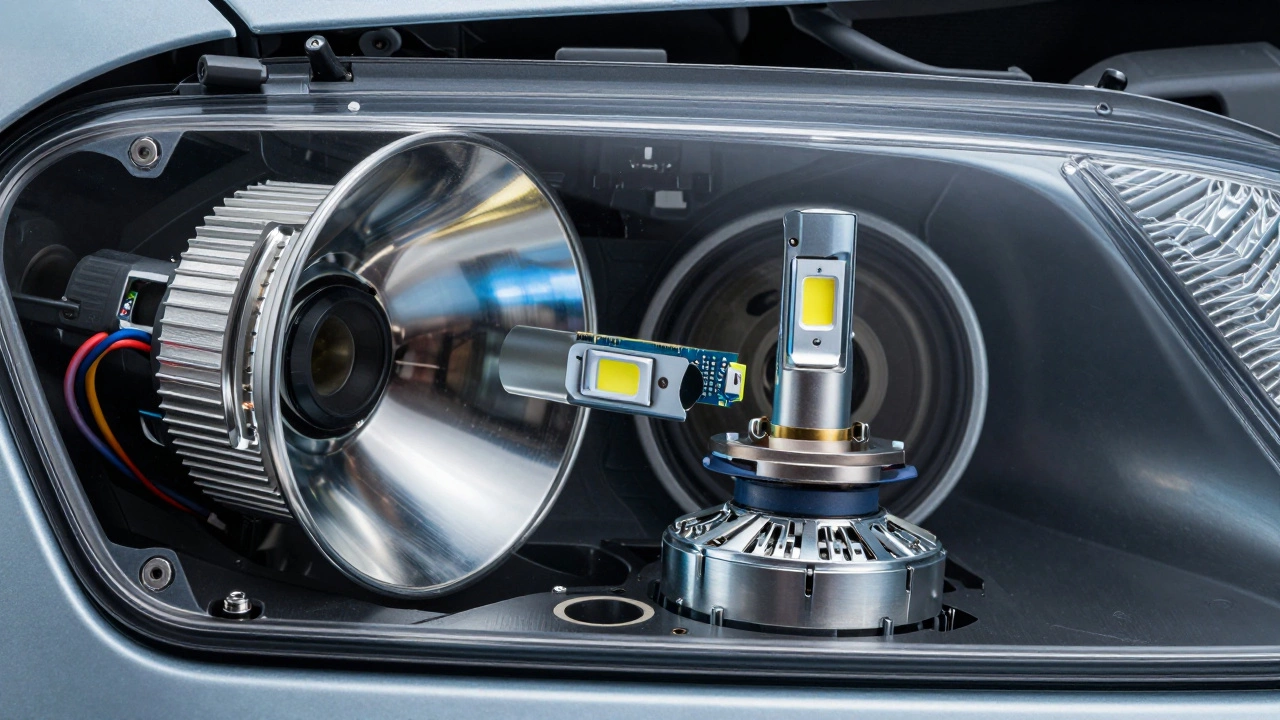
A conversion kit solves this by including a precise optical lens or a specialized reflector cup that mimics the original point-source behavior. It forces the LED light to behave like the halogen light your car expects. Without this component, you aren’t upgrading your lights; you’re breaking them.
What Actually Goes Into a Conversion Kit?
When you buy a reputable LED conversion kit, you aren’t just getting a bulb. You are getting a mini-electrical system packaged into a compact unit. Understanding these components helps you avoid cheap knockoffs that fail within months.
- The LED Emitter: High-quality kits use COB (Chip on Board) or CSP (Chip Scale Package) technology. Look for brands that specify the chip manufacturer, such as Osram or Philips. Cheap kits use generic chips that dim quickly over time.
- The Driver Module: LEDs run on direct current (DC), but your car battery provides alternating current (AC) spikes and varying voltage. The driver regulates this power. A good driver prevents flickering when you start the engine or hit bumps in the road.
- The Heat Sink: LEDs hate heat. While they produce less heat than halogens, the heat they do generate stays concentrated at the chip. Aluminum heat sinks with copper cores draw this heat away. If the heat sink is plastic or undersized, the LED will burn out.
- The Fan (Optional): Some kits include tiny fans to force air over the heat sink. While effective, fans add moving parts that can fail due to vibration or dust. Fanless designs with massive heat sinks are often more reliable for long-term use.
- Mounting Hardware: Since LED bases don’t always match halogen sockets perfectly, kits include adapters, clips, and wire harnesses to secure the unit firmly in place.
Halogen vs. HID: Which Base Are You Upgrading From?
Your starting point dictates the complexity of your conversion. Most older and mid-range vehicles use halogen bulbs (H4, H7, H11, 9005, 9006). These are relatively easy to convert. You simply remove the old bulb and install the LED kit into the existing housing.
However, if your car came with HID (High-Intensity Discharge) or Xenon lights, things get trickier. HID systems use a ballast-a bulky box that steps up voltage to create an arc between electrodes. You cannot simply plug an LED into an HID socket without bypassing or removing the ballast. Many HID-to-LED kits come with inline drivers that mimic the resistance of the ballast so your car’s computer doesn’t throw an error code. In some cases, you may need to physically cut wires or modify the wiring harness, which pushes the modification beyond a simple DIY swap.
| Feature | Halogen | HID (Xenon) | LED |
|---|---|---|---|
| Lifespan | 500-1,000 hours | 2,000-3,000 hours | 15,000-50,000+ hours |
| Power Consumption | 55 Watts | 35-55 Watts | 20-35 Watts |
| Light Output (Lumens) | ~1,000 lumens | ~2,800 lumens | 3,000-6,000+ lumens |
| Warm-up Time | Instant | 1-3 seconds | Instant |
| Conversion Difficulty | N/A (Stock) | Complex (Ballast issues) | Moderate (Kit required) |
Legal Implications: Is It Street Legal?
This is where most people get caught out. Just because you can install an LED kit doesn’t mean you should if you want to stay on the right side of the law. In many jurisdictions, including Australia, the US, and the EU, aftermarket LED conversions are technically illegal unless the entire headlight assembly is certified for LED use.
Headlights are tested as a complete unit: the bulb, the reflector, and the lens. When you mix an uncertified LED bulb with a halogen-certified housing, you alter the photometric performance. Even if the kit claims to be "DOT" or "E-Marked," these marks often apply only to the bulb itself, not its performance in a non-LED housing.
In Adelaide, where I live, the Department for Infrastructure and Transport conducts random vehicle inspections. If your headlights scatter light above the cutoff line, causing glare for oncoming drivers, you can be fined and forced to revert to stock halogens. To stay legal, you have two options: buy factory-upgraded LED headlight assemblies (expensive) or ensure your conversion kit is specifically designed to maintain the OEM beam pattern and check local regulations carefully. For off-road or track-only vehicles, these rules are much looser.
Installation Pitfalls to Avoid
Installing an LED conversion kit is generally easier than replacing an alternator, but there are common mistakes that lead to failure.
- Ignoring Airflow: Halogen housings are sealed. Adding an LED generates heat inside that sealed environment. Ensure the kit fits tightly enough to prevent moisture ingress but allows for any necessary ventilation if the design permits. Moisture + Electronics = Corrosion.
- Forcing the Fit: If the LED base doesn’t click into place easily, stop. You might be fighting the locking tab or the rubber boot. Use the adapters provided in the kit. Forcing it can crack the housing or break the electrical contacts.
- Reversing Polarity: Unlike halogens, LEDs are polarity-sensitive. If the light doesn’t turn on, try rotating the connector 180 degrees. Never cut wires to fix this; use the reversible connectors included in quality kits.
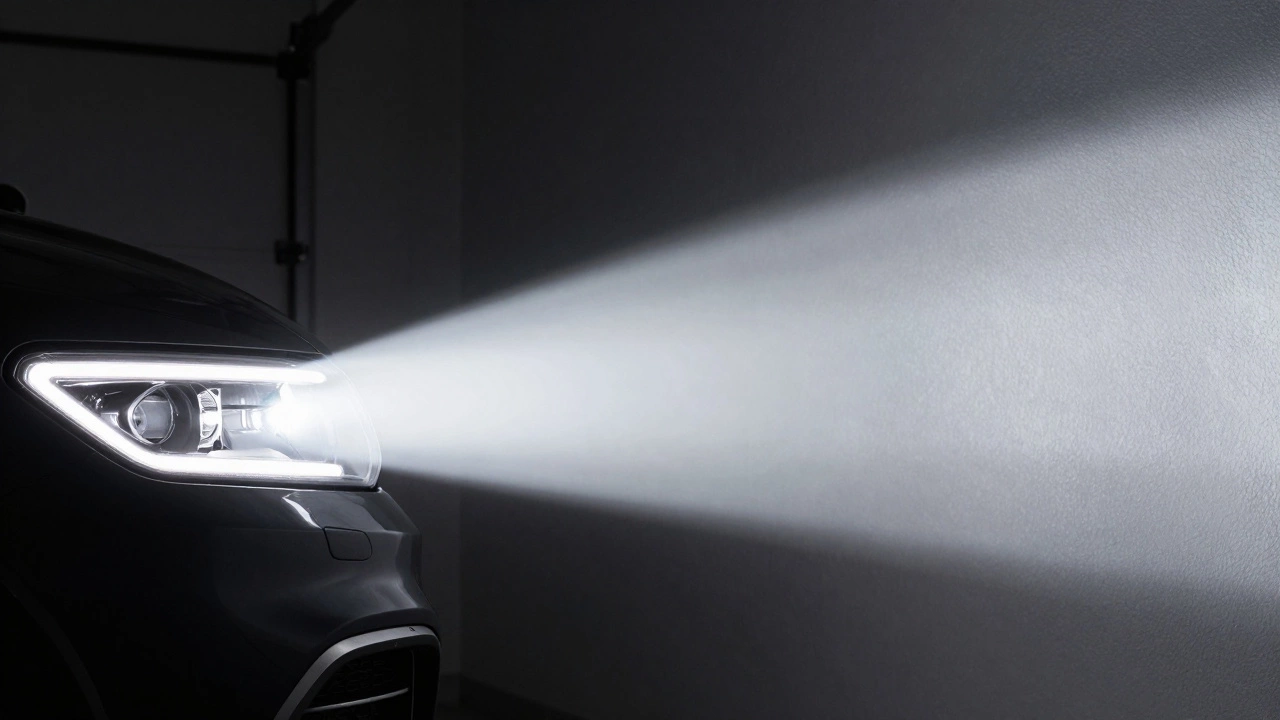
- Skipping the Test Drive: Before sealing everything up, turn on the lights and check the beam pattern on a wall. Adjust the aim screws on the back of the headlight housing. LEDs are brighter, so even a slight upward tilt can blind others. Aim low and wide.
Cost vs. Value: Is It Worth It?
A decent LED conversion kit costs between $50 and $150 AUD for a pair. Factory LED headlight assemblies can cost $800 to $2,000 AUD per side, plus labor. So, financially, the conversion kit is a no-brainer.
The value proposition goes beyond money. Visibility improves dramatically. The color temperature of LEDs (usually 5000K to 6000K) mimics daylight, reducing eye strain during night driving. Objects appear sharper, and depth perception improves. Plus, you won’t be changing bulbs every year. With a lifespan of 30,000 hours, you’ll likely sell the car before the LEDs die.
However, if your car is a classic or a high-value collector item, modifying the lighting can decrease resale value. Purists prefer original equipment. For daily drivers, especially older models with fading halogens, the upgrade significantly enhances safety and convenience.
Final Verdict: Do You Need the Kit?
Yes, you need a dedicated conversion kit. Do not buy bare LED bulbs marketed as "plug and play" for halogen housings unless they explicitly include the necessary optics and adapters. A proper kit ensures the light is focused, safe, and durable. It bridges the gap between outdated halogen technology and modern LED efficiency. Invest in a brand with a warranty, read the installation instructions twice, and adjust your beam height meticulously. Your eyes-and the eyes of oncoming drivers-will thank you.
Can I install LED bulbs directly into my halogen headlight housing?
Technically, you can physically insert them, but it is highly discouraged. Halogen housings are designed for a point-source filament. LEDs emit light from a broader area, causing scattered light, poor beam patterns, and potential glare for other drivers. A conversion kit includes optics to correct this.
Are LED headlight conversions legal in Australia?
In most Australian states, including South Australia, aftermarket LED conversions in halogen housings are not street-legal unless the entire assembly is certified. They may pass visual inspection but fail technical scrutiny regarding beam pattern and glare. Always check local transport authority regulations.
Do LED headlights drain the car battery faster?
No, LEDs are more energy-efficient. A typical halogen bulb uses 55 watts, while an equivalent LED uses 20-35 watts. This reduces the load on your alternator and battery, potentially extending their life.
How long do LED conversion kits last?
Quality LED kits with proper heat dissipation can last 30,000 to 50,000 hours. This is significantly longer than halogen bulbs (500-1,000 hours) and HID bulbs (2,000-3,000 hours). Failure is usually due to poor heat management or water damage, not the LED chips themselves.
Will my car’s computer detect the LED bulbs?
Some modern cars monitor bulb resistance. Since LEDs draw less power, the car might think the bulb is blown and display an error message. Many conversion kits include CANbus decoders or resistors to trick the computer into recognizing the lights as functional.