Car Sound Modification Simulator
Select your goal or current modification to see the acoustic reality.
Select your goals above to see how different components affect your car's sound profile.
You just spent good money on a shiny new performance air filter, and you’re hoping it’ll make your car growl like a beast. But here’s the cold splash of reality: swapping that paper rectangle for a cotton gauze cone usually changes the intake sound, not the exhaust sound. If you’re expecting a deeper rumble from the tailpipes, you might be disappointed. However, if you want to hear more of the engine’s breathing under acceleration, this mod delivers exactly that.
Let’s clear up the confusion once and for all. We’ll break down why the sound shifts, what actually controls your exhaust note, and how to get the acoustic upgrade you’re really after without wasting cash on the wrong parts.
The Physics of Engine Noise
To understand why your car sounds different (or doesn’t), you need to know where the noise comes from. An internal combustion engine makes two distinct types of noise. First, there’s the mechanical noise from pistons slamming up and down and valves opening and closing. Second, there’s the explosive force of burning fuel, which creates pressure waves that travel out through the exhaust system.
Air enters the engine through the intake system. This is where your air filter lives. Its job is to trap dirt while letting air flow in. A standard factory filter uses dense paper media. It’s efficient at cleaning air but restricts airflow slightly, acting as a muffler for the intake noise. When you accelerate hard, you hear a faint whistling or humming because the air is being forced through those tight paper fibers.
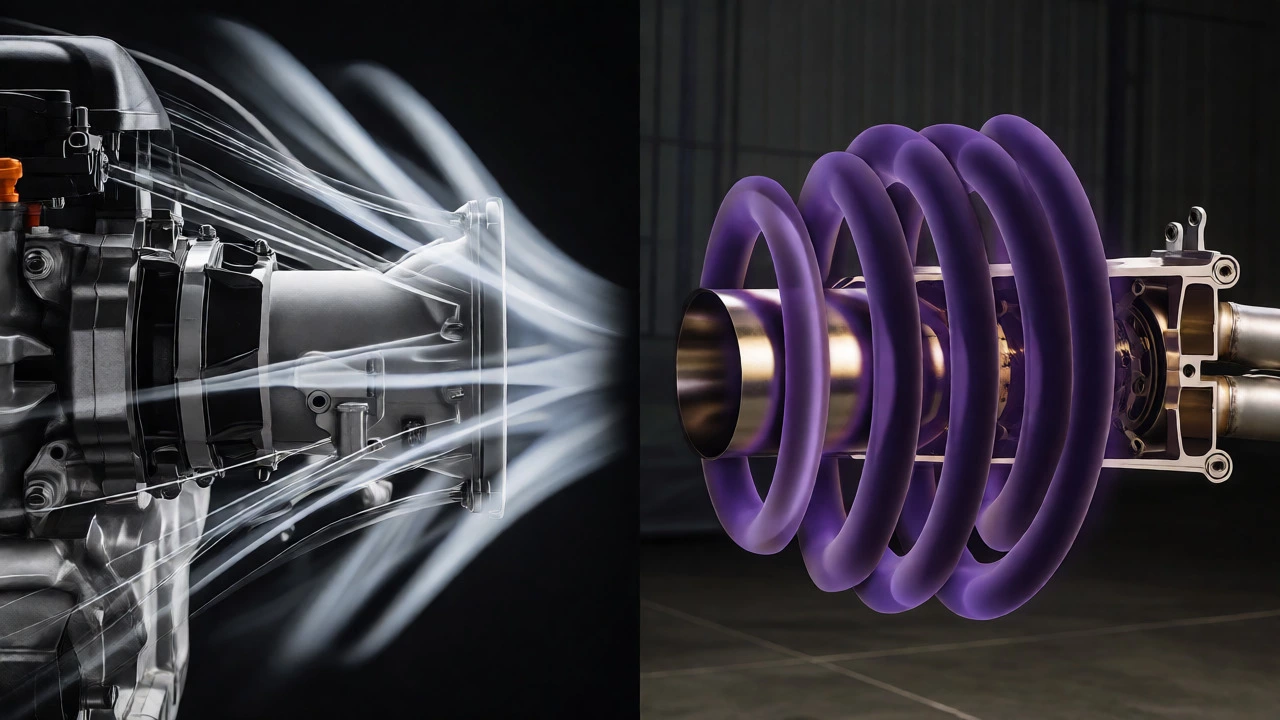
Performance filters, often made from oiled cotton gauze or synthetic mesh, have much larger pores. They allow more air to pass with less resistance. Because the air moves faster and more freely, the turbulence increases. This creates a louder, more aggressive "induction roar" inside the cabin and near the front of the car. But crucially, this happens before the air even mixes with fuel and ignites. The exhaust system handles the noise after ignition. So, changing the input side rarely changes the output side significantly.
Why You Hear More Noise (But Not From the Exhaust)
If you drive a car with a performance intake, you’ll notice the sound profile shifts. Instead of the muffled hum of a stock setup, you hear a crisp whoosh when you step on the gas. This is especially noticeable in turbocharged engines. Turbo cars rely on compressed air, and unrestricted intake systems can amplify the compressor surge or "flutter" sound during gear changes.
However, don’t confuse induction noise with exhaust drone. Induction noise is high-pitched and airy. Exhaust noise is low-frequency and rumbly. A performance air filter cannot lower the frequency of your exhaust note. It can’t make your V6 sound like a V8. What it does do is unmask the engine’s natural character. If your engine has a naturally raspy idle, you’ll hear that rasp more clearly because the intake isn’t masking it with its own filtered hum.
There is one exception: resonance. Sometimes, removing restrictive intake components changes the harmonic balance of the whole vehicle. In rare cases, this can excite certain frequencies in the exhaust manifold or pipes, making them vibrate slightly more. But this is a subtle effect, not a dramatic change in tone.

What Actually Changes Exhaust Sound?
If your goal is a louder, deeper exhaust note, you need to look downstream from the engine. The exhaust system is designed to dampen the violent explosions of combustion. To change the sound, you have to alter how those pressure waves are managed.
Here is a breakdown of what truly impacts exhaust acoustics:
| Component | Primary Impact on Sound | Secondary Effect |
|---|---|---|
| Catalytic Converter | Filters high-frequency hiss; dulls sound | Removing it adds raw, metallic tone |
| Muffler | Reduces volume and cancels specific frequencies | Deleting it increases volume drastically |
| Exhaust Tips | Cosmetic only (mostly) | Slight backpressure change if very narrow |
| Performance Air Filter | Increase in intake induction noise | Negligible impact on exhaust tone |
The catalytic converter is the biggest tone-shaper. It contains ceramic honeycomb structures that scrub pollutants. These structures also act as a resonator, smoothing out sharp edges in the sound wave. Replace a clogged cat with a high-flow metal substrate, and you’ll hear a slight increase in clarity. Delete the cat entirely (where legal), and you’ll get a raw, unfiltered bark.
The muffler is next. It uses chambers and baffles to cancel out noise waves. A straight-pipe exhaust removes these cancellations, resulting in maximum volume. But remember, volume isn’t the same as quality. Many enthusiasts prefer a deep burble over sheer loudness. Achieving that requires careful tuning of pipe diameters and chamber sizes, not just an air filter swap.
When Does an Air Filter Seem to Change Exhaust Tone?
You might read forum posts claiming their car sounds deeper after installing a cold air intake. Why would they say that if physics says otherwise? There are three common reasons for this perception.
- Psychological Bias: You spent $300 on a part. Your brain wants to justify the cost. You interpret any new noise as an improvement.
- ECU Remapping: Often, people install an intake and then pay for a tune. The tune alters fueling and timing, which genuinely changes combustion characteristics and thus exhaust sound. The intake didn’t do it; the software did.
- Leakage: If the new intake isn’t sealed properly, unmetered air leaks into the engine. This causes rough idling and misfires, which can create a sputtering, uneven exhaust note that some mistake for "character."
Be honest with yourself. If you haven’t touched the exhaust hardware or the ECU map, your exhaust sound hasn’t changed. You’re just hearing the engine breathe louder from the front.
Pros and Cons of Performance Air Filters
So, should you buy one? It depends on your goals. If you want better throttle response and a sportier auditory feedback loop, yes. If you want a muscle-car rumble, no.
On the positive side, many drivers report improved throttle sensitivity. With less restriction, the engine reacts quicker to pedal inputs. The induction noise provides immediate feedback, telling you exactly how hard the engine is working. This can make driving more engaging, especially in manual transmission cars.
On the downside, maintenance is higher. Cotton gauze filters need regular cleaning and re-oiling. Over-oiling can foul your Mass Air Flow (MAF) sensor, causing check engine lights and poor performance. Paper filters are "install and forget," while performance filters require care. Also, in dusty environments like outback Australia, a poorly maintained performance filter can let more grit into the engine than a high-quality paper one.
How to Get the Sound You Want
If you’re chasing a specific sound, follow this decision tree:
- Want more intake whoosh? Install a performance air filter or short ram intake. Ensure it’s well-sealed.
- Want a deeper rumble? Look at your exhaust system. Consider a cat-back system with larger piping and less restrictive mufflers.
- Want both? Do both. Combine a free-flowing intake with a tuned exhaust. This gives you the best of both worlds: aggressive breathing and a powerful exhaust note.
- Want power too? Add an ECU remap. This optimizes the air-fuel mixture for the new hardware, unlocking actual horsepower gains alongside the sound improvements.
Remember, sound is subjective. One person’s "aggressive growl" is another person’s "drone." Test drive modified cars before buying parts. Listen to the difference between intake noise and exhaust noise. Once you can distinguish them, you’ll spend your modification budget much more wisely.
Will a performance air filter make my car louder overall?
It will make the engine bay louder due to increased induction noise, but it typically does not increase the volume coming from the exhaust tips. Overall exterior noise levels may rise slightly, but the dominant change is the shift from muffled hum to sharper whooshing sounds.
Does removing the air box change the sound more than just the filter?
Yes. The air box acts as a large resonator and sound damper. Removing it exposes the filter directly to the engine bay, allowing more noise to escape. A simple filter swap inside the existing box changes sound less dramatically than switching to an open-element cold air intake.
Can a dirty air filter affect exhaust sound?
Indirectly, yes. A severely clogged filter restricts airflow, causing the engine to run rich or struggle. This can lead to incomplete combustion, potentially causing popping or spitting from the exhaust due to unburnt fuel igniting in the hot exhaust stream.
Is the sound change permanent?
The sound change persists as long as the filter is installed and clean. However, if the filter gets oily or dirty, airflow decreases, and the noise may revert closer to stock levels. Regular maintenance keeps the intended sound profile consistent.
Do turbo cars sound different with performance filters?
Turbocharged vehicles often show a more noticeable change. Unrestricted intake allows the turbo to spool more freely, sometimes enhancing the audible whistle or flutter sounds associated with turbo lag and blow-off valves. This is an intake-related acoustic change, not an exhaust one.