Custom Exhaust Cost Estimator
Cost Breakdown
You just bought a car that sounds like a lawnmower, or maybe you want your daily driver to rumble like a V8. You walk into a shop, ask for a full custom exhaust, and the mechanic quotes you a number that makes you choke on your coffee. Is it $1,500? $3,000? More? The truth is, there’s no single sticker price. It depends entirely on what you want the system to do and how much metal they have to bend.
Think of it like ordering a suit. An off-the-rack blazer costs one thing. A bespoke suit tailored to your exact measurements with Italian wool costs another. A custom exhaust is the latter. In Adelaide, where we love our cars and our coastal air (which eats mild steel), knowing the real costs helps you avoid getting ripped off or under-equipped. Let’s break down exactly where your money goes so you can budget without guessing.
The Baseline: Off-the-Shelf vs. Custom Fabrication
Before we talk about custom prices, you need to understand the alternative. If you buy a "cat-back" system from a brand like Borla or Flowmaster, you’re buying a pre-made pipe kit. It’s cheaper because they mass-produced it. Installation takes two hours. Total cost might be $1,200-$2,500 AUD depending on the car.
A full custom exhaust is different. It starts as straight pipes, mandrel bends, mufflers, and tips. The fabricator cuts, welds, and shapes everything on-site to fit your specific chassis. Why pay more? Because off-the-shelf systems often have restrictive bends that kill top-end power, and they rarely sound exactly how you want them to. Custom gives you control over tone, volume, and flow.
For most street cars in Australia, a decent custom job starts around $2,500. That’s your entry ticket. Anything below that usually means cutting corners on material thickness or skipping proper hanger support, which leads to rattles within six months.
Material Matters: Mild Steel vs. Stainless Steel
This is the biggest factor in your quote. If you live near the coast-like here in Adelaide-the salt air is brutal on exhausts. Using cheap materials is a false economy.
| Material | Estimated Cost (AUD) | Lifespan | Best For |
|---|---|---|---|
| Mild Steel | $1,800 - $2,400 | 2-4 years | Daily drivers, low budget, inland areas |
| Stainless Steel (304) | $2,800 - $4,500 | 10+ years | Coastal areas, performance cars, resale value |
| Titanium | $6,000+ | Lifetime | Track cars, weight savings enthusiasts |
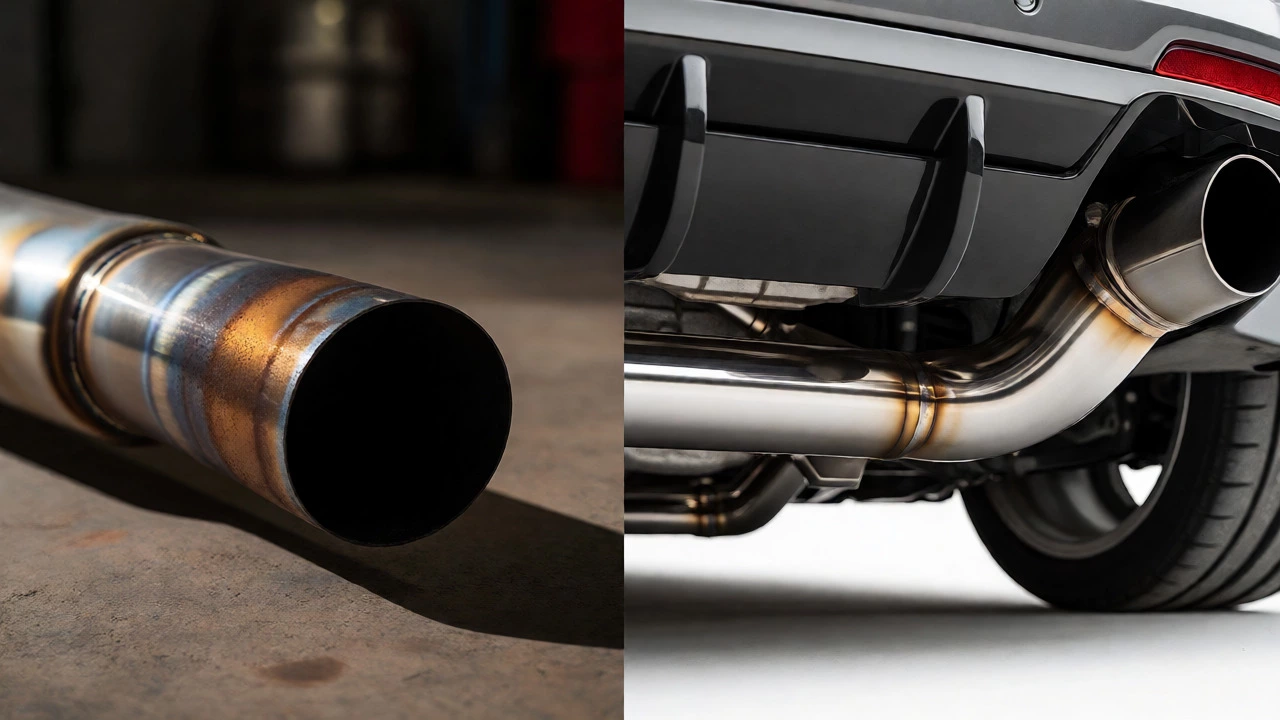
Why the huge jump between mild steel and stainless? It’s not just rust resistance. Stainless flows better because you can use thinner walls without losing strength, allowing for larger diameters. Also, polishing stainless looks incredible under the lights. Mild steel turns brown and flaky. If you plan to keep the car more than three years, spend the extra $1,000 on stainless. It pays for itself in avoided replacements.
System Configuration: Cat-Back, Axle-Back, or Header-Back?
When people say "full custom," they often mean different things. Clarify this with your fabricator immediately, because the labor hours change drastically.
- Axle-Back: Replaces everything behind the rear axle. Includes mufflers and tips. Cheapest option. Labor: 3-4 hours. Cost impact: Low.
- Cat-Back: Starts after the catalytic converters. This is the sweet spot for most people. You get better sound and flow without messing with emissions sensors. Labor: 5-7 hours. Cost impact: Medium.
- Header-Back: Removes the stock headers and replaces the entire system down to the tailpipe. This requires removing engine components and dealing with oxygen sensor bungs. Labor: 8-12 hours. Cost impact: High.
If you want maximum power gains, header-back is the way. But if you just want a deeper note and a bit more throttle response, cat-back is sufficient. Don’t let a shop upsell you into header-back work if you don’t need the airflow improvements. It adds unnecessary risk of check-engine lights if the O2 sensors aren’t transferred correctly.
The Hidden Costs: Catalytic Converters and Tuning
Here’s where budgets explode. Your quote for pipes and mufflers isn’t the final bill. Two things will add hundreds, sometimes thousands, to the total.
First, catalytic converters. If your custom design removes the stock cats, you need high-flow aftermarket ones. These aren’t cheap. A pair of quality metallic substrate cats can cost $800-$1,500 alone. Do not remove cats unless you are racing. In Australia, removing cats fails roadworthy inspections and smells terrible when cold-starting.
Second, ECU tuning. When you open up the exhaust flow, your engine breathes differently. The factory computer doesn’t know this. Without a tune, you might lose low-end torque or trigger lean-burn errors. A basic dyno tune ranges from $400 to $800. Skip this, and you’ve wasted half the potential of your new exhaust.
Labor Rates and Shop Variance
In major cities like Sydney or Melbourne, fabrication shops charge $120-$180 per hour. In regional areas, it might drop to $90-$110. But remember, custom work isn’t just bolt-on time. It’s design time, test-fitting, welding, and grinding.
A complex custom job involves:
1. Lifting the car and measuring clearances.
2. Mocking up the piping route.
3. Cutting and welding joints (TIG welding is preferred for cleanliness).
4. Installing hangers and brackets.
5. Test driving and adjusting for drone.
Ask for a fixed-price quote rather than hourly. Hourly billing on custom work can spiral if the fabricator hits unexpected clearance issues with subframes or fuel tanks. A reputable shop will inspect first, then give a firm price.
Saving Money Without Sacrificing Quality
You don’t have to empty your savings account to get a great-sounding exhaust. Here are practical ways to cut costs:
- Keep Stock Headers: Unless you’re building a turbo monster, stock headers are fine. Saves $500-$1,000 in parts and labor.
- Single Muffler Design: Dual exhaust systems look cool but require double the piping, hangers, and labor. A well-designed single-outlet system with a large-diameter pipe (e.g., 3-inch) flows almost as well and costs 30% less.
- Local Fabricators: Big brand names charge for marketing. Find a local TIG welder who specializes in exhausts. They’ll often beat national chain prices by 20% while providing better attention to detail.
- Reuse Components: If your current mufflers are in good shape, ask if they can be reused. Or, buy used stainless tips online instead of paying retail.
What Does "Good Sound" Actually Cost?
Sound preference is subjective, but physics dictates cost. To get a deep, aggressive rumble without annoying drone inside the cabin, you need precision. Cheap systems drone because the frequencies clash with the car’s interior resonance.
Achieving a "clean" tone often requires adding resonators or X-pipes/H-pipes. These mix the exhaust pulses from both banks of cylinders. Adding an H-pipe to a V8 can smooth out the idle rumble significantly. This adds $300-$500 to the build but transforms the character of the car. If you hate drone, budget for these mixing chambers. Don’t skip them to save a few dollars, only to regret it on the highway.
Final Verdict: Budgeting for Your Build
So, how much should you set aside? Here’s a realistic breakdown for a standard sedan or hatchback in Australia in 2026:
- Budget Build: Mild steel, cat-back, single outlet, basic muffler. Expect $1,800-$2,200.
- Quality Street Build: Stainless steel, cat-back, dual outlets, H-pipe, polished tips. Expect $2,800-$3,500.
- Premium Performance: Stainless, header-back, high-flow cats, custom tuning. Expect $4,500-$6,000+.
Remember, the exhaust is part of the car’s identity. It’s what people hear before they see it. Spending an extra $500 for better stainless steel and professional TIG welding ensures it lasts a decade and sounds right every time you start the engine. Cheap exhausts rattle, rust, and annoy. Good ones sing.
Is a custom exhaust worth it over a universal cat-back?
Yes, if you care about fitment and sound quality. Universal kits often leave gaps, rattle against heat shields, and produce harsh tones. Custom systems are measured to your car's specific dimensions, eliminating vibration and allowing precise control over the exhaust note. However, for a simple daily driver, a high-quality brand-name cat-back is often more cost-effective.
How long does it take to install a full custom exhaust?
Typically 1 to 3 days at a shop. While the physical welding might take 6-10 hours, shops schedule these jobs around other lifts. Complex header-back swaps involving engine removal can take longer. Always ask for a completion date, not just a start date.
Will a custom exhaust void my warranty?
In Australia, modifications generally don't void the entire warranty, but they can void coverage related to the modified component. If your exhaust causes damage to the catalytic converter or ECU due to improper tuning, those repairs won't be covered. Keep receipts and ensure the work is done by a licensed mechanic to maintain legal standing under consumer law.
Does stainless steel really last longer than mild steel?
Significantly, especially in coastal climates. Mild steel begins to rust internally and externally within 2-3 years in salty air. Grade 304 Stainless Steel resists corrosion indefinitely under normal conditions. Over a 10-year period, replacing mild steel twice costs more than installing stainless once.
Can I drive with a leaking custom exhaust?
You can, but you shouldn't. Leaks introduce carbon monoxide into the cabin, which is dangerous. They also cause loud drone and reduce engine efficiency. Fix leaks immediately; it's usually a simple clamp or weld repair costing $50-$100.