Carbon Fiber Lifespan Estimator
Estimated Results
- Base Material Potential: --
- Environmental Impact: --
- Maintenance Bonus: --
You just installed that aggressive front splitter or sleek rear spoiler made of carbon fiber is a composite material consisting of thin carbon filaments woven into fabric and bonded with resin to create a structure stronger than steel yet significantly lighter. It’s the gold standard for performance enthusiasts who want to shed weight without sacrificing rigidity. The look is sharp, the weight savings are real, but there’s a nagging question in the back of your mind: how long will it actually last before cracking, delaminating, or fading under the harsh Australian sun?
The short answer? If you treat it right, carbon fiber can outlast the metal chassis of your car. We’re talking 15 to 20 years, potentially even longer. But if you ignore it, slap it on with cheap adhesive, and park it under direct UV exposure without protection, you might see structural failure or ugly yellowing in as little as two to three years. It’s not magic; it’s chemistry and physics. Let’s break down what determines whether your investment becomes a permanent upgrade or a costly mistake.
The Material Science: Why Carbon Fiber Doesn't Rust
To understand longevity, you have to understand what you’re looking at. Unlike steel, which corrodes when exposed to moisture and salt, or aluminum, which can oxidize, carbon fiber is inert. The fibers themselves don’t rot, rust, or degrade from water. They are essentially strands of pure carbon atoms arranged in a crystalline structure parallel to the length of the fiber. This gives them incredible tensile strength-about five times that of steel, by weight.
However, carbon fiber isn’t just fibers. It’s a composite. You have the carbon fiber reinforcement providing the strength, and the polymer matrix (usually epoxy or polyester resin) acts as the glue holding those fibers together. This matrix transfers loads between the fibers and protects them from abrasion and environmental damage. The weak link in this chain is rarely the fiber itself; it’s almost always the resin or the bond between layers.
In Adelaide, where we get intense UV radiation and fluctuating temperatures, the resin faces the biggest challenge. Over time, UV rays can break down the chemical bonds in the resin, leading to surface chalking, loss of gloss, and eventually, micro-cracking. High-quality pre-preg carbon fiber uses advanced epoxy resins that resist this degradation far better than the wet-layup polyester resins often found in cheaper aftermarket parts. If you bought a $50 "carbon" bumper cover from an online marketplace, check if it’s real carbon or just plastic with a carbon-fiber print. Real carbon has a distinct weave pattern visible through the clear coat, whereas fake versions look flat and uniform.
Real-World Lifespan Scenarios
So, what does this mean for your daily driver? The lifespan varies wildly based on three factors: quality of manufacture, installation method, and environmental exposure. Here is a realistic breakdown of what you can expect:
- OEM Quality Pre-Preg Parts: These are manufactured under heat and pressure in autoclaves, ensuring maximum fiber-to-resin ratio and minimal voids. With proper care, these can last 15-20+ years. Think factory carbon roof panels on high-end sports cars.
- High-Quality Aftermarket Wet Layup: Hand-laid parts using good epoxy resin. Expect 10-15 years. These are common among reputable tuning shops. They are durable but may suffer from slight cosmetic degradation faster than pre-preg.
- Budget/Entry-Level Parts: Often use polyester resin and lower-grade fibers. Lifespan drops to 3-7 years. These are prone to yellowing, delamination (layers separating), and cracking under impact.
- Fake "Carbon Look" Plastic: Not carbon fiber at all. Just ABS or polyurethane with a printed texture. Lifespan is purely cosmetic; the print fades in 1-2 years, and the plastic yellows.
I’ve seen owners keep their original carbon fiber hoods for over a decade with nothing more than regular washing and waxing. I’ve also seen splitters crack after one winter because they were mounted too rigidly, transferring road vibration directly into the brittle composite. Context matters.
The Enemies of Carbon Fiber Longevity
If carbon fiber is so strong, why do parts fail? It usually comes down to one of four enemies: UV radiation, physical impact, improper mounting, and chemical exposure.
1. Ultraviolet (UV) Radiation
This is the silent killer. While the carbon fibers themselves are immune to UV, the resin and the clear coat are not. Prolonged exposure breaks down the polymer chains in the resin, causing it to become brittle. On the surface, you’ll notice the glossy finish turning matte or chalky. In severe cases, the resin degrades enough to expose the raw fibers, which then absorb moisture and lead to internal delamination. Always apply a UV-inhibiting ceramic coating or high-quality wax specifically designed for composites. Don’t skip this step.
2. Impact and Abrasion
Carbon fiber is stiff, but it’s not flexible like steel. Steel bends; carbon cracks. A minor curb scrape that would leave a dent on a fender can cause a spiderweb crack in a carbon mirror housing. Because the material doesn’t deform to absorb energy, the force travels through the structure until it finds a weak point. This is why aerodynamic components like spoilers and diffusers need to be mounted with flexible adhesives or rubberized standoffs to allow for slight flex during cornering and braking.
3. Improper Installation
This is the most common reason for premature failure. Many DIYers bolt carbon parts directly to the car’s body using hard metal bolts. As the car vibrates, the hard bolt points act as stress concentrators. Over time, this vibration fatigues the material around the bolt hole, causing cracks to radiate outward. The fix? Use nylon or Teflon washers, flexible urethane adhesives, or ensure the mounting hardware allows for microscopic movement. Never overtighten bolts on carbon fiber; you’re likely to strip the threads or crush the laminate.
4. Chemical Exposure
While resistant to many substances, carbon fiber composites can be damaged by strong solvents, acetone, or certain brake cleaners. Avoid using harsh degreasers directly on carbon surfaces. Stick to pH-neutral car shampoos. Bird droppings and bug splatter contain acids that can etch the clear coat if left for days, especially in hot weather. Wash them off promptly.
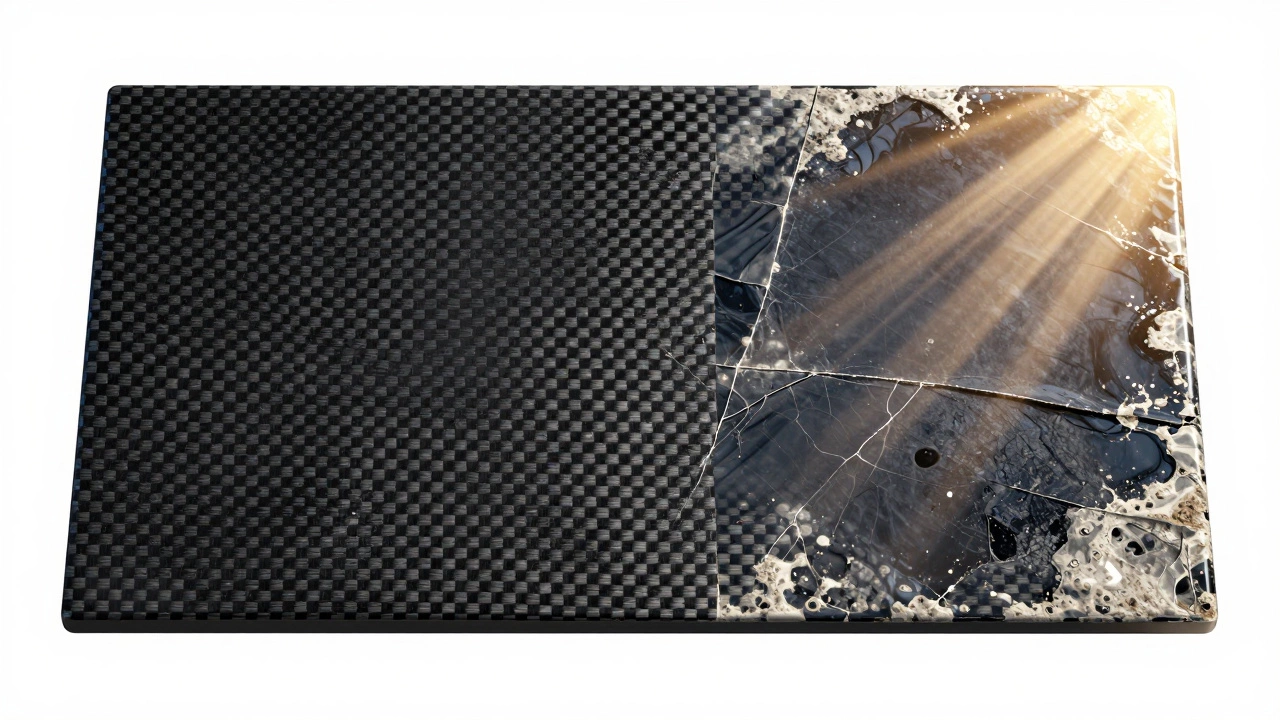
Maintenance Routine to Extend Life
You don’t need to baby carbon fiber, but you do need to respect it. Here’s a simple routine to ensure your parts last as long as possible:
- Regular Washing: Wash every two weeks using the two-bucket method to prevent swirl marks. Swirls aren’t just cosmetic; they compromise the clear coat’s ability to shield the resin from UV.
- Sealant or Ceramic Coating: Apply a dedicated ceramic coating annually. Products containing silicon dioxide (SiO2) create a hydrophobic layer that repels dirt and blocks UV rays. This is the single best thing you can do for longevity.
- Inspect Mounting Points: Every six months, check the bolts and adhesive on spoilers, splitters, and side skirts. Tighten loose bolts gently, but replace any cracked mounting brackets immediately.
- Avoid Automatic Car Washes: Those spinning brushes are abrasive nightmares. They trap grit against the surface and can scratch the clear coat deeply. Hand wash only.
- Park Smart: If possible, park in shade or use a breathable car cover. Constant direct sunlight accelerates resin degradation.
Repair vs. Replace: When Is It Done?
Let’s say you’ve got a crack in your carbon fiber hood. Do you toss it? Not necessarily. Carbon fiber is highly repairable, unlike crumpled steel. Minor scratches can be polished out. Deeper cracks can be filled with matching resin and carbon patches, then sanded and clear-coated. For small cosmetic repairs, you can often do this yourself with a kit.
However, structural damage is different. If a load-bearing component like a roll cage bar or a suspension mount shows signs of delamination (you can hear a hollow sound when tapping it) or significant cracking, replace it. Structural integrity cannot be fully guaranteed after major repair unless done by a professional composite technician with vacuum bagging equipment. Safety first.
| Type | Resin Used | Manufacturing Process | Expected Lifespan | Best For |
|---|---|---|---|---|
| Pre-Preg | High-performance Epoxy | Autoclave (Heat/Pressure) | 15-20+ Years | OEM replacements, critical aero parts |
| Wet Layup (Epoxy) | Standard Epoxy | Hand Layup / Vacuum Bag | 10-15 Years | Aftermarket body kits, hoods |
| Wet Layup (Polyester) | Polyester/Vinyl Ester | Hand Layup | 3-7 Years | Budget accessories, non-critical parts |
| Carbon-Look Plastic | N/A (Printed Texture) | Injection Molding | 1-3 Years (Cosmetic) | Temporary styling, low-budget builds |
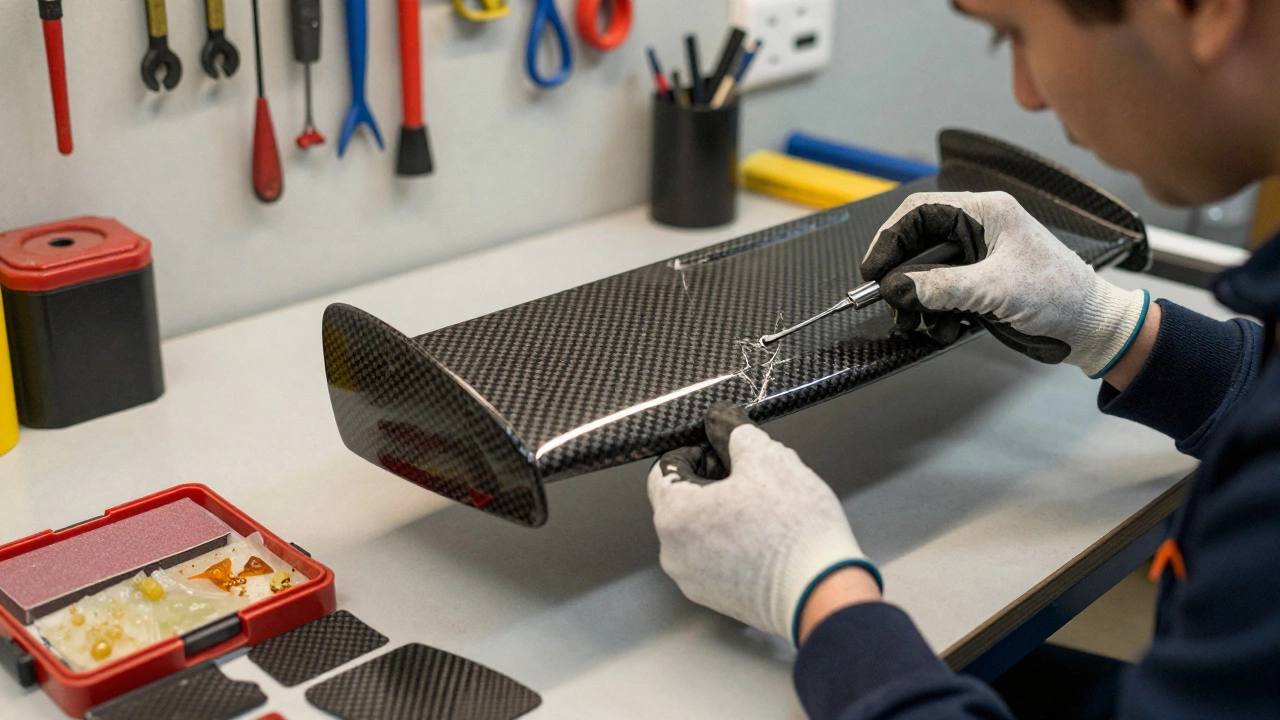
Signs Your Carbon Fiber Is Failing
Don’t wait for a part to fall off. Watch for these warning signs:
- Delamination: Visible separation between layers, often appearing as bubbles or bulges. Tap the area; a dull thud instead of a sharp click indicates internal failure.
- Chalking: A white, powdery residue on the surface that won’t wipe away easily. This means the clear coat and top layer of resin are breaking down.
- Crazing: Fine, hairline cracks spreading across the surface. This is often due to UV damage or thermal cycling.
- Loose Fasteners: If bolts keep coming loose, the mounting holes may be elongating or the surrounding material is compressing.
Addressing these issues early can extend the life of the part by several years. Ignoring them leads to catastrophic failure, especially on moving parts like spoilers that experience aerodynamic lift forces at speed.
Is Carbon Fiber Worth the Investment?
If you’re asking about lifespan, you’re likely weighing the cost. Carbon fiber parts are expensive. A genuine carbon fiber hood can cost anywhere from $800 to $3,000 depending on the car and manufacturer. Compare that to a steel hood replacement, which might be $300 but adds 30-40kg of weight. The value proposition isn’t just durability; it’s performance and aesthetics.
For track cars or serious daily drivers, the weight reduction improves handling, braking, and acceleration. The stiffness reduces flex, making steering more precise. And yes, the look turns heads. But if you’re buying cheap, poorly manufactured carbon fiber just for the appearance, you’re setting yourself up for disappointment. Poorly made parts fade, crack, and look worse than stock within a few years. Invest in reputable brands that use pre-preg or high-quality epoxy processes, and maintain them properly. That’s the secret to making carbon fiber last a lifetime.
Does carbon fiber rust?
No, carbon fiber does not rust. Rust is the oxidation of iron, and carbon fiber contains no iron. It is composed of carbon filaments and resin, both of which are resistant to corrosion. However, the metal fasteners used to mount carbon parts can rust if not treated, so use stainless steel or coated bolts.
Can you paint over carbon fiber?
Yes, you can paint carbon fiber, but it requires proper preparation. The surface must be thoroughly cleaned and lightly sanded to create a bonding profile. Use a primer designed for composites, followed by basecoat and clearcoat. Painting hides the weave pattern, which is often the main aesthetic appeal, so consider this carefully.
How do you know if carbon fiber is real or fake?
Real carbon fiber has a visible, irregular weave pattern that changes angle slightly across the surface due to the molding process. It feels smooth but has a subtle texture. Fake carbon fiber often looks like a flat, repeating print with no depth. Real carbon is also significantly lighter than fiberglass or plastic alternatives of the same shape.
Will carbon fiber crack in cold weather?
Carbon fiber itself is not affected by cold temperatures. However, extreme cold can make the resin matrix more brittle, increasing the risk of cracking upon impact. Additionally, thermal expansion and contraction cycles between the carbon part and the metal body can stress mounting points. Ensure flexible mounting solutions are used in climates with wide temperature swings.
Is it safe to drive with cracked carbon fiber?
It depends on the location and severity. Cosmetic cracks on a non-structural panel like a trunk lid are generally safe temporarily. However, cracks in structural components like suspension mounts, roll cages, or aerodynamic wings that bear load are dangerous. Delamination compromises strength unpredictably. Replace or professionally repair structural cracks immediately.