Exhaust Legality & Sound Estimator
Select your current or planned exhaust configuration to estimate its legal risk and sound character. Note: This is an estimation tool; always verify with local transport authorities.
Please select options and click "Analyze" to see results.
You want that deep, aggressive rumble when you hit the gas. You don't want a police officer pulling you over for sounding like a lawnmower with a death wish. It’s a tricky balance. Most people think "loud" equals "fast," but in the eyes of the law-and your neighbors-it usually just equals trouble. The good news? You can absolutely upgrade your exhaust note without breaking the rules or getting fined. It just requires understanding how sound works and what your local regulations actually say.
Before we talk about pipes and mufflers, let's look at why your car sounds the way it does. An internal combustion engine is a machine that converts fuel into motion by creating controlled explosions inside cylinders. These explosions create pressure waves-sound-that travel out through the exhaust system. The stock system is designed to dampen this noise significantly. When you modify it, you are essentially removing those sound barriers. But here is the catch: removing them incorrectly creates drone (that annoying hum at highway speeds) or excessive volume that triggers decibel limits.
Understand the Legal Noise Limits
Every region has different rules, but most follow similar guidelines based on decibels (dB). In Australia, where I’m writing from, the general rule for passenger vehicles is often around 90-95 dB(A) at idle or under acceleration, depending on the state. For example, South Australia enforces strict noise pollution laws where modifications that exceed manufacturer specifications can lead to immediate fines. If you’re elsewhere, check your local transport authority’s specific dB limits. Don’t guess. A cheap decibel meter app on your phone isn’t accurate enough for court; if you’re worried, get a professional reading.
The key metric isn’t just peak volume. It’s also frequency. Laws often target low-frequency drone because it travels further and penetrates walls better than high-pitched noises. If your mod adds a lot of bass rumble but keeps the overall dB level down, you’re in a safer zone legally than someone who just cut off their muffler entirely.
Cat-Back vs. Axle-Back: Where to Start
If you want a better sound without turning your car into a nuisance, start with a cat-back exhaust, which is an aftermarket system that replaces everything from the catalytic converter back to the tailpipes. This is the sweet spot for most enthusiasts. Why? Because it leaves the catalytic converter intact. The cat is crucial for emissions and helps smooth out some harsh frequencies. Removing the cat (a "test pipe") makes the car louder and raspier, but it often trips check-engine lights and fails emissions tests.
An axle-back system, on the other hand, only replaces the components behind the rear axle. It’s cheaper and easier to install, but it offers less control over the tone. You might get a louder note, but you won’t necessarily get a *better* one. Cat-back systems allow manufacturers to tune the resonance chambers more precisely, giving you that desirable growl without the headache-inducing drone.
Mufflers Are Not Just Silencers
People hate mufflers. They think they kill power. Modern engineering says otherwise. A well-designed performance muffler is a chambered or straight-through device that reduces noise while maintaining flow efficiency. There are two main types:
- Chambered Mufflers: These use internal baffles and expansion chambers to cancel out specific sound frequencies. They tend to produce a deeper, throatier tone. Brands like Borla are famous for this style. They are generally quieter and more street-friendly.
- Straight-Through Mufflers: These have a perforated core wrapped in sound-absorbing material. They offer less restriction, potentially freeing up a few horsepower, but they let more high-frequency noise through. If you go this route, ensure the packing material is high-quality fiberglass or steel wool, not cheap cotton that blows out after six months.
If you want to stay legal, avoid "glasspacks" or basic universal silencers unless you pair them with resonators. A standalone glasspack often results in a tinny, unrefined sound that screams "cheap modification."
The Role of Resonators
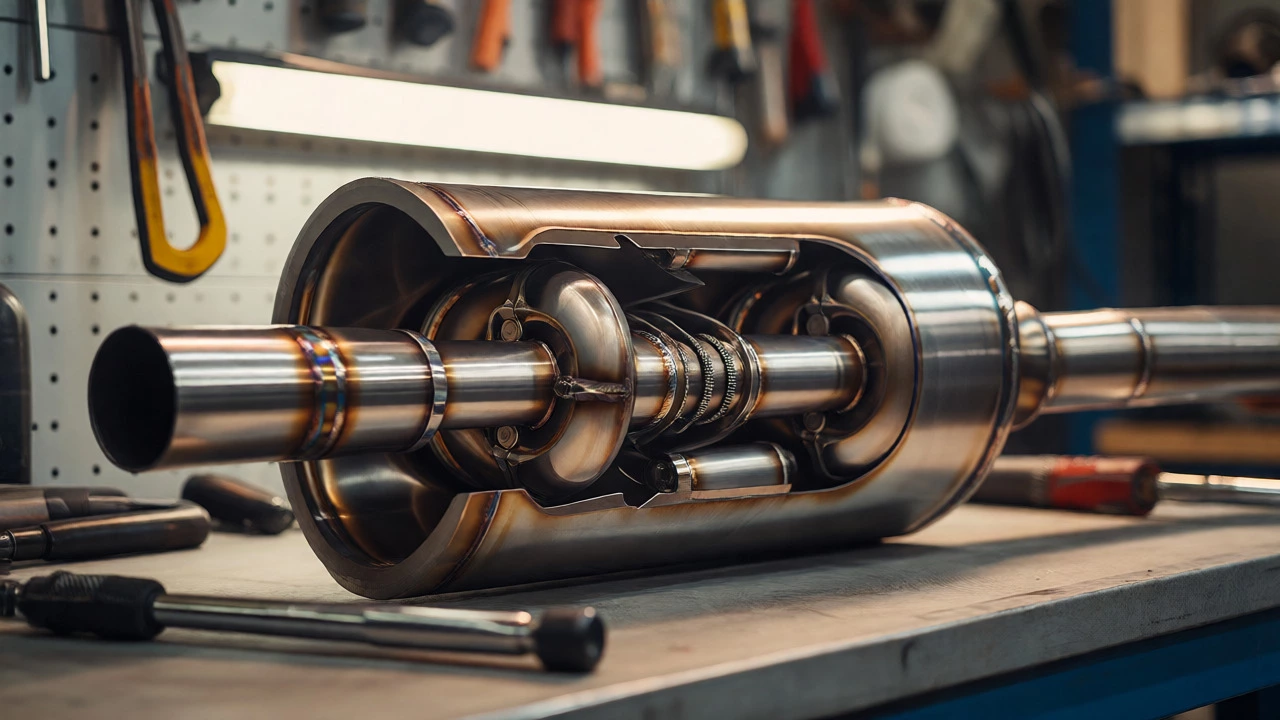
This is the secret weapon for legal exhaust mods. A resonator is a small cylindrical component placed before the muffler to cancel out specific unwanted frequencies. Think of it as a noise filter. It doesn’t make the car quiet; it makes the car *pleasant*. It removes the raspy, high-pitched whine that happens at mid-range RPMs. By installing a larger-diameter resonator, you can keep the exhaust loud at full throttle but smooth out the noise during daily driving. This helps you pass noise checks because the average sound level drops, even if the peak volume remains punchy.
Materials Matter: Stainless Steel vs. Aluminized
Your choice of metal affects both durability and sound quality. Stainless steel is a corrosion-resistant alloy containing chromium, ideal for long-lasting exhaust systems. It resists rust, which means your system won’t develop leaks or holes that change the sound unpredictably over time. Aluminized steel is cheaper but corrodes faster, especially in coastal areas like Adelaide. Once it starts rusting, the sound gets rattly and inconsistent. If you want a consistent, legal sound for years, pay extra for T304 stainless steel.
| Component | Sound Impact | Legal Risk | Cost Estimate (AUD) |
|---|---|---|---|
| Stock System | Quiet, muted | None | $0 |
| Axle-Back | Louder, slightly raspy | Low-Medium | $400 - $800 |
| Cat-Back (Chambered) | Deep, refined growl | Low | $1,200 - $2,500 |
| Test Pipe + Muffler Delete | Very loud, droney | High | $600 - $1,000 |

Install Tips to Keep It Quiet
Even the best exhaust will sound bad if installed poorly. Here is how to ensure your mod stays legal and pleasant:
- Use Hangers, Not Straps: Metal-on-metal contact creates vibration noise. Ensure all hangers are rubber or polyurethane and not touching the chassis directly.
- Check for Leaks: A leak at the manifold gasket sounds worse than a loud exhaust. It creates a ticking or popping noise that is hard to fix later. Torque bolts to spec.
- Heat Wrap Carefully: Some people wrap headers to reduce heat soak. While this doesn’t change the exhaust note much, poor wrapping can trap moisture and cause rust. Use high-quality titanium wrap if you do it.
- Tune the ECU: If you remove any restrictions (like cats), your air-fuel ratio changes. A proper tune ensures the engine runs efficiently, preventing misfires that sound like gunshots.
What About Loudness Apps?
Police increasingly use smartphone apps calibrated with external microphones to measure noise. These apps aren’t perfect, but they are consistent. To test your setup, drive at a steady 2,000-3,000 RPM past a friend holding a calibrated meter. If it reads above 90 dB(A), you’re pushing your luck. Remember, context matters. A loud exhaust at a track day is fine. The same exhaust cruising through a residential suburb at 10 PM might get you a ticket.
Common Pitfalls to Avoid
Don’t fall for the "straight pipe" myth. Straight pipes are illegal in almost every jurisdiction for road cars. They remove all sound attenuation. You’ll regret it the first time you try to hear your radio or have a conversation with a passenger. Also, beware of "universal" mufflers sold online without fitment data. They often require cutting and welding that alters the exhaust length, changing the resonance unpredictably. Stick to vehicle-specific kits from reputable brands.
Finally, consider the social cost. Even if you’re technically legal, being the loudest car on the block makes you unpopular. A refined, deep note commands respect. A shrill, obnoxious bark invites complaints. Aim for quality over quantity.
Does deleting the catalytic converter make my car louder?
Yes, removing the catalytic converter increases volume and creates a raspier tone. However, it often causes check-engine lights due to oxygen sensor errors and may fail emissions inspections. It is rarely worth the hassle for street-driven cars.
Can I be fined for exhaust noise even if it looks stock?
Absolutely. Police measure decibel levels, not appearance. A modified internal baffle in a stock-looking shell can still exceed legal noise limits. If it sounds too loud, it likely is too loud.
What is the difference between drone and rumble?
Drone is a constant, irritating hum heard at highway speeds, caused by resonance in the exhaust pipe. Rumble is a low-frequency pulse heard during acceleration. Drone is generally considered unpleasant and can be fixed with resonators; rumble is often desired for a sporty feel.
Do tip extensions affect sound?
Minimal effect. Tip extensions are mostly cosmetic. They might add a tiny amount of resistance, but they won’t significantly change the tone or volume unless they are extremely narrow and restrictive.
Is a cat-back exhaust legal everywhere?
Generally, yes, provided it retains the catalytic converter and meets local decibel limits. Always verify with your local transport authority, as some regions have stricter noise ordinances than others.