Steel vs. Alloy Wheel Decision Tool
Answer these three questions to find out which wheel type is best for your vehicle.
Why this fits you:
Trade-offs to consider:
You walk into a tire shop or browse an online auto parts store, and you see two options listed: "mags" and "rims." You might even hear friends arguing about which one looks better or performs better. But here is the truth that most people miss: you are likely comparing apples to oranges because the terms themselves are often used incorrectly. In the world of alloy wheels, the debate isn't really about mags versus rims; it is about material composition, weight distribution, and how your car handles on the road.
If you have been driving for any length of time, you know that wheels do more than just hold your tires. They affect your fuel economy, your braking distance, and how your suspension absorbs bumps. So, when someone asks, "Which is better?", they are usually asking, "Should I stick with my stock steel wheels or upgrade to lighter, stronger alloys?" Let’s clear up the confusion once and for all so you can make a choice that actually improves your drive.
The Terminology Trap: What Are We Actually Talking About?
Before we weigh the pros and cons, we need to fix the vocabulary. This is crucial because buying the wrong thing happens when you don’t know what you’re calling it. Technically, a "rim" is only the outer edge of the wheel-the part that seals against the tire bead. It is a tiny component of the whole assembly. When people say "rims," they almost always mean the entire wheel.
Then there are "mags." Short for magnesium, these were the high-performance wheels of the 1970s and 80s. They were incredibly light but also brittle and expensive to cast. Today, true magnesium wheels are rare in consumer vehicles. Most modern "mag wheels" are actually aluminum alloys. So, when you see "mags" advertised today, you are almost certainly looking at aluminum alloy wheels that are made from a mix of aluminum, silicon, magnesium, and manganese for strength and weight reduction.
This means the real comparison is between steel wheels (often called "rims" by mistake) and alloy wheels (often called "mags"). Understanding this distinction changes everything. You aren't choosing between two different styles of the same object; you are choosing between two fundamentally different engineering approaches to rotating mass.
Steel Wheels: The Workhorse Option
Let’s start with the baseline. Most cars come from the factory with steel wheels. Why? Because steel is cheap, strong, and easy to manufacture. If you have ever seen a spare tire in your trunk, it is almost certainly mounted on a steel wheel. These wheels are designed to survive abuse, not to look good or enhance performance.
Steel wheels are made from stamped sheets of steel that are welded together. This process makes them durable and resistant to cracking under heavy impact. If you hit a large pothole at speed, a steel wheel is more likely to bend out of shape than shatter. This is a critical safety feature. A bent wheel can be straightened by a professional; a cracked alloy wheel usually needs to be replaced entirely.
However, steel has a major downside: weight. Steel is dense. A typical set of four steel wheels can weigh significantly more than their alloy counterparts. This extra weight is "unsprung mass," which is weight that is not supported by the suspension. High unsprung mass makes your shocks and struts work harder to keep the tires in contact with the road. The result? A harsher ride, slower acceleration, and reduced fuel efficiency. Your engine has to burn more gasoline to move those heavier wheels every time you accelerate.
Additionally, steel wheels rust. Unless they are painted or coated, exposure to salt and moisture will eat away at the metal over time. This is why many drivers cover them with hubcaps or plastic trim pieces to hide the corrosion and improve aesthetics.
Alloy Wheels: The Performance Upgrade
Now let’s look at the alternative. Alloy wheels are typically made from aluminum mixed with other metals like silicon, magnesium, or manganese. This mixture creates a material that is lighter than steel but still strong enough to handle the stresses of daily driving. The manufacturing process usually involves casting or forging, which allows for complex, intricate designs that steel cannot achieve.
The biggest advantage of alloy wheels is weight reduction. By reducing unsprung mass, you improve your car’s handling. Lighter wheels allow the suspension to react faster to bumps and dips, keeping the tires planted on the road. This translates to better grip during cornering and shorter braking distances. Think about it: if your wheels are lighter, your brakes don’t have to work as hard to stop the rotational momentum.
There is also a thermal benefit. Aluminum conducts heat better than steel. Brakes generate a lot of heat, and if that heat gets trapped around the wheel, it can lead to brake fade-a dangerous condition where your brakes lose effectiveness. Alloy wheels help dissipate this heat more efficiently, keeping your braking system cooler and more reliable during aggressive driving or long descents.
Aesthetically, alloy wheels win hands down. They can be finished in various ways-polished, painted, machined-to match your car’s style. They fill the wheel well nicely and give your vehicle a sharper, more modern look. For many car enthusiasts, the visual upgrade alone justifies the switch.
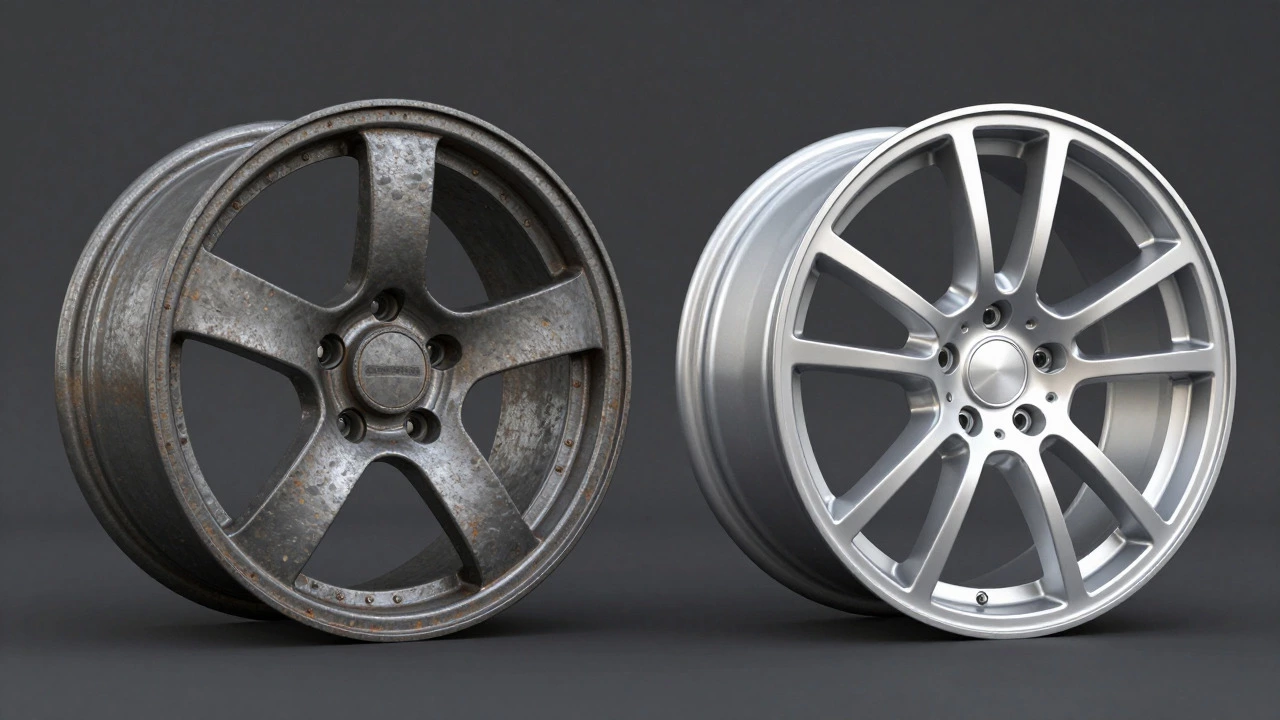
Direct Comparison: Weight, Durability, and Cost
To make this concrete, let’s look at how these two options stack up across the metrics that matter most to drivers. This table breaks down the key differences between standard steel wheels and modern alloy wheels.
| Feature | Steel Wheels | Alloy Wheels |
|---|---|---|
| Weight | Heavy (High unsprung mass) | Light (Low unsprung mass) |
| Durability | Bends on impact; repairable | Cracks on impact; often replaceable |
| Heat Dissipation | Poor | Excellent |
| Cost | Low ($50-$100 per wheel) | High ($150-$500+ per wheel) |
| Rust Resistance | Prone to rust without coating | Corrosion-resistant finish |
| Performance Impact | Neutral to negative | Positive (better handling/braking) |
Notice the trade-off. Steel wins on cost and impact resistance. Alloy wins on performance, heat management, and looks. There is no single "best" option; it depends entirely on how you use your car and what you value most.
When Should You Stick With Steel?
Despite the hype around alloy wheels, steel remains the smart choice for specific scenarios. If you live in an area with terrible roads, deep potholes, or lots of gravel, steel wheels are more forgiving. They absorb shock better and are less likely to suffer catastrophic failure from a hard hit. Mechanics can often bend a steel wheel back into shape, saving you hundreds of dollars.
Steel is also ideal for winter driving. In cold climates, you might want to save your nice alloy wheels for summer and mount snow tires on cheap steelies. This protects your expensive alloys from road salt and curbs while giving you a dedicated setup for winter conditions. Additionally, if you tow heavy loads frequently, the added strength and durability of steel can provide peace of mind, although high-quality forged alloys are also suitable for towing.
For budget-conscious buyers, steel wheels are unbeatable. If your primary goal is to get from point A to point B without spending a fortune on replacements, steel does the job reliably. They are also easier to balance due to their uniform construction, which can mean fewer vibrations at highway speeds.

When Are Alloy Wheels Worth the Investment?
If you enjoy driving, alloy wheels are almost always worth the upgrade. The improvement in handling is noticeable immediately. Your car feels more responsive, steering inputs are sharper, and the ride quality smooths out because the suspension can work more effectively. For sports cars, sedans, and SUVs used on paved roads, the performance benefits outweigh the higher initial cost.
Alloy wheels are also better for fuel economy. While the savings per gallon might seem small, over the life of the vehicle, the reduced weight adds up. Lighter wheels mean less energy required to rotate them, which directly translates to lower fuel consumption. In an era of rising gas prices, this is a practical consideration.
Resale value is another factor. Cars with well-maintained alloy wheels often command a higher price than those with dented or rusty steel wheels. Buyers perceive alloy wheels as a premium feature, and they add a level of sophistication that steel simply cannot match. If you plan to sell your car in the future, investing in quality alloys can boost its market appeal.
Maintenance Tips for Both Types
No matter which type you choose, proper maintenance extends the life of your wheels. For steel wheels, regular inspection for rust is key. Apply a touch-up paint to any chips in the coating to prevent corrosion from spreading. Check for bends after hitting potholes, and have them aligned promptly to avoid uneven tire wear.
For alloy wheels, cleanliness is crucial. Brake dust contains iron particles that can etch into the clear coat of alloy wheels if left too long. Wash your wheels regularly with a pH-neutral cleaner designed for alloys. Avoid using harsh brushes or abrasive pads that can scratch the finish. If you notice cracks or significant curb rash, inspect them closely. Small cracks can propagate under stress, leading to wheel failure. Always torque lug nuts to the manufacturer’s specification to prevent warping or stripping threads.
Final Verdict: Making the Right Choice
So, which is better, mags or rims? If you define "mags" as modern alloy wheels and "rims" as steel wheels, the answer depends on your priorities. Choose steel if you prioritize cost, durability in rough conditions, or need a dedicated winter setup. Choose alloy wheels if you want better handling, improved braking, enhanced aesthetics, and slightly better fuel efficiency.
For most daily drivers on paved roads, alloy wheels offer the best balance of performance and style. They transform the look of your car and make it feel more agile. However, if you are on a tight budget or drive on poor roads, steel wheels remain a robust, economical choice. Ultimately, the "best" wheel is the one that fits your driving habits, your budget, and your local environment.
Are mag wheels actually made of magnesium?
Most modern "mag wheels" are not made of pure magnesium. They are typically made from aluminum alloys that may contain small amounts of magnesium for strength. True magnesium wheels are rare, expensive, and mostly found in vintage race cars or high-end custom builds due to their brittleness and cost.
Can you repair a cracked alloy wheel?
Minor cracks in alloy wheels can sometimes be repaired through welding and machining, but it is not always recommended. Structural integrity can be compromised, especially under high stress. For safety-critical areas, replacement is often the safer option. Bent steel wheels, however, are much easier and cheaper to repair.
Do alloy wheels improve gas mileage?
Yes, alloy wheels can improve gas mileage slightly. Because they are lighter than steel wheels, they reduce unsprung mass. This means your engine doesn't have to work as hard to accelerate and maintain speed, leading to better fuel efficiency. The exact improvement varies by vehicle and driving conditions.
Why are steel wheels still used if alloys are better?
Steel wheels are cheaper to manufacture and more durable against impacts. They are ideal for base-model cars, winter tires, and vehicles driven on rough roads. Their ability to bend rather than crack makes them safer in certain high-impact scenarios and easier to repair.
How often should I clean my alloy wheels?
You should clean your alloy wheels at least once a month, or more frequently if you drive in dusty or salty conditions. Brake dust can corrode the wheel finish over time, so regular cleaning with a pH-neutral alloy wheel cleaner helps maintain their appearance and longevity.