Ever heard a loud, aggressive exhaust note on a street car and wondered how they got that sound? One common trick is a resonator delete. It’s not a full exhaust replacement, but it’s one of the cheapest and most effective ways to change how your car sounds-and sometimes how it performs. But what does a resonator delete actually do? And is it worth it for your car?
What Is a Resonator, Anyway?
Most factory exhaust systems have three main parts: the headers, the catalytic converter, and the muffler. Between the catalytic converter and the muffler, you’ll often find a resonator. It’s a smaller, cylindrical metal chamber-usually about 6 to 12 inches long-that’s not meant to reduce volume like a muffler. Instead, it cancels out specific engine frequencies.
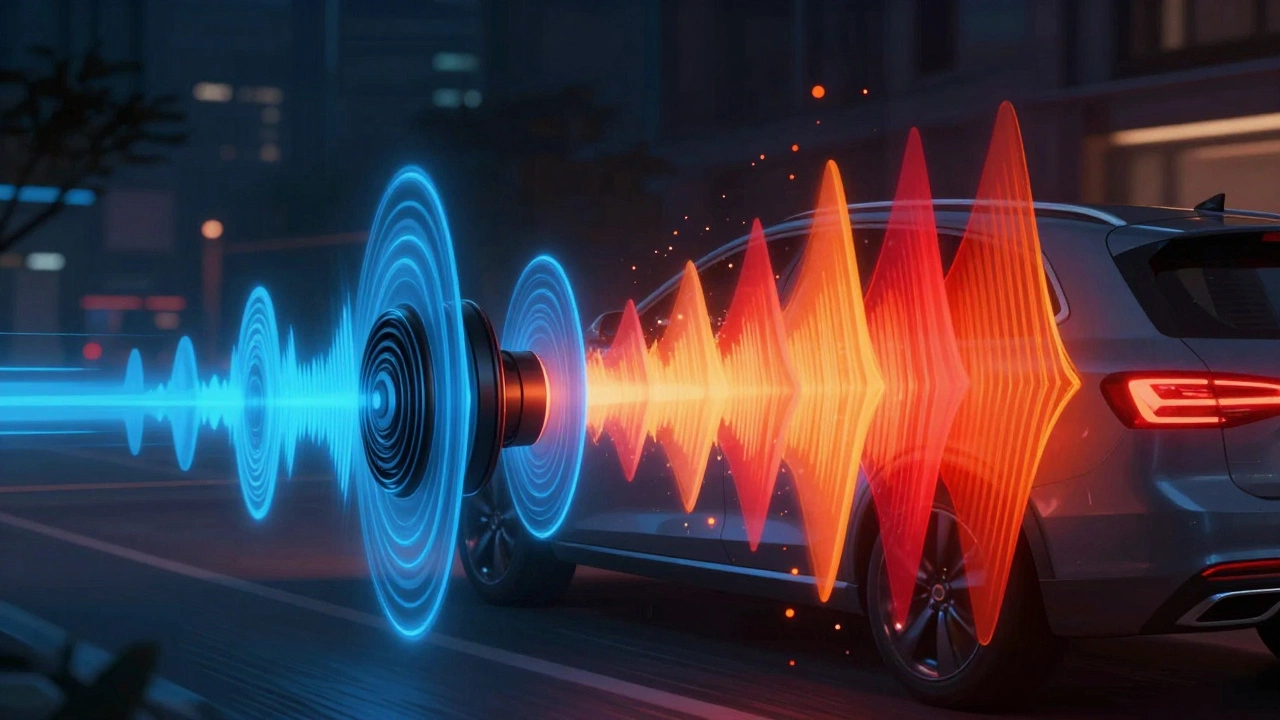
Think of it like noise-canceling headphones for your exhaust. Engines produce certain drone frequencies, especially around 1,800 to 2,500 RPM on highway cruising. That low, annoying buzz you hear on long drives? That’s the resonator working to smooth it out. It doesn’t make the car quieter overall-it targets one annoying tone so the rest of the exhaust sounds more pleasant.
What Happens When You Remove It?
A resonator delete means cutting out that chamber and welding the exhaust pipe back together. You’re not removing the muffler, so the car won’t sound like a jet engine. But you are removing the part that cancels out those mid-range frequencies. The result? A louder, more aggressive exhaust note with more bass and a deeper rumble.
On a V6 or inline-4, you’ll notice the difference right away. The engine will sound rawer, more mechanical. On a V8, it’ll become more throaty and less muffled. It’s not just about volume-it’s about tone. You lose the "polished" sound and gain a more "unfiltered" one.
Some people say it makes the car sound "more expensive." Others say it sounds "cheap" or "nasal." It depends on your car and your ears. A Subaru WRX with a resonator delete sounds like a rally car. A Honda Civic Type R sounds like it’s screaming. A Toyota 86 becomes a proper sports car.
Does It Add Power?
This is the big myth. Many people think removing the resonator adds horsepower. It doesn’t-not noticeably. The resonator is a low-restriction part. It doesn’t choke the exhaust flow like a clogged muffler or small-diameter pipe. Removing it might save you 1 to 3 psi of backpressure, but that’s not enough to make a measurable difference on a dyno.
Real power gains come from upgrading the entire exhaust system: headers, high-flow cats, larger pipes, and a performance muffler. A resonator delete is purely an audio mod. If you’re looking for more power, you’re better off with a full cat-back system. But if you just want your car to sound meaner without spending $1,000+, the resonator delete is the cheapest way to do it.
Will It Trigger a Check Engine Light?
No. The resonator has nothing to do with emissions sensors or oxygen sensors. Those are located before and after the catalytic converter. As long as you don’t remove the catalytic converter or tamper with the upstream sensors, your car won’t throw a code.
Some people confuse resonator deletes with cat deletes. A cat delete can trigger a check engine light because it affects the downstream O2 sensor readings. A resonator delete? Zero impact on emissions monitoring. Your car will run perfectly fine.
What About Drone?
This is the trade-off. Without the resonator, you lose the frequency cancellation. That means highway drone becomes louder. At 110 km/h on the freeway, you might hear a constant low-frequency hum that gets annoying after 30 minutes. It’s not the same as a loud exhaust-it’s more like a vibrating pressure wave that gets inside your skull.
Some cars handle it better than others. A car with a longer wheelbase and better sound insulation (like a Mustang) might not be as bad. A compact hatchback with thin walls (like a Hyundai i30) can feel like you’re inside a bass speaker. If you drive long distances often, the drone might drive you crazy.
There’s no way to predict drone without trying it. Some people love the sound and don’t mind the drone. Others regret it after a week. If you’re unsure, look up videos of your exact car model with a resonator delete. Listen with headphones. Pay attention to the 2,000 RPM range.
Is It Legal?
In Australia, exhaust modifications are regulated under the Australian Design Rules (ADRs). A resonator delete is a gray area. It’s not explicitly illegal if the catalytic converter is still in place and emissions are within limits. But if your exhaust is too loud, police can pull you over under noise regulations.
Adelaide has strict noise testing for modified vehicles. If your car sounds like a drag racer at idle or under acceleration, you’re likely to get a fine or be forced to revert it. Most state road authorities don’t care about the resonator itself-they care about decibel levels. A resonator delete can push your car over the legal limit, especially if paired with a loud muffler.
It’s also worth noting: insurance companies may consider a resonator delete a modification. If you’re in an accident and they find out you’ve modified the exhaust, they could deny a claim if they believe it contributed to reckless driving behavior. Always check with your insurer before making changes.
How Is It Done?
The process is simple. A mechanic cuts out the resonator and welds the two exhaust pipe ends back together. Some people use clamps for a temporary fix, but that’s not durable. Welding is the only way to make it last.
Cost? Around $100 to $200 in labor if you bring in the parts. You can buy a resonator delete pipe online for $30 to $80, depending on your car. Some brands make direct-fit pipes that bolt right in. Others require custom cutting and welding.
DIY? Possible if you have a saw, grinder, and welder. But exhaust pipes are heavy, hot, and coated in rust. Most people leave it to a shop. A good exhaust shop can do it in under an hour.

Who Should Do It?
Resonator deletes are perfect for:
- Enthusiasts who want a more aggressive sound without spending big
- Owners of naturally aspirated cars that sound too quiet
- People who don’t drive long distances regularly
- Those who plan to upgrade the full exhaust later
It’s not for:
- People who drive on highways every day
- Those who live in noise-sensitive areas
- Anyone who plans to sell the car soon (it reduces resale value)
- Drivers who want a refined, quiet ride
Alternatives to a Resonator Delete
If you want more sound but less drone, there are better options:
- Performance muffler: Replaces the entire rear section. Better sound control, less drone, more power potential.
- Valved exhaust: Lets you switch between quiet and loud modes. Great for daily driving and track days.
- Resonator replacement: Swap the factory resonator for a glasspack or straight-through design. Less drone, more tone.
These cost more-$500 to $1,500-but they’re smarter long-term investments. A resonator delete is a quick fix. A full system upgrade is a real upgrade.
Final Verdict
A resonator delete is a cheap, easy way to make your car sound more exciting. It doesn’t add power. It doesn’t hurt reliability. But it can make your daily drive louder-and sometimes, that’s exactly what you want.
Just know what you’re getting into. If you hate highway drone, don’t do it. If you want a full exhaust upgrade, save up for one. But if you’re on a budget and just want your car to wake up a little, a resonator delete is the simplest way to do it.
Test it on a friend’s car first. Listen. Feel it. Then decide.
Does a resonator delete make your car louder?
Yes, but not in the way most people think. It doesn’t make the exhaust louder overall-it removes the part that cancels out certain engine frequencies. This makes the sound deeper, more aggressive, and more noticeable, especially at cruising speeds. The volume increase is subtle, but the tone changes dramatically.
Will a resonator delete damage my engine?
No. The resonator is just a sound-tuning component. Removing it doesn’t affect engine performance, airflow, or emissions. Your car’s ECU doesn’t even know it’s gone. As long as the catalytic converter and oxygen sensors are intact, your engine will run exactly as it did before.
Does a resonator delete affect fuel economy?
No measurable effect. Any change in fuel economy is so small it’s lost in normal driving variations. Some drivers report slightly worse fuel economy because they drive more aggressively after the mod. But that’s behavior, not physics.
Can I reverse a resonator delete?
Yes, but it’s not always easy. If the original resonator was cut out and the pipes were welded together, you’ll need to cut the pipe again and install a new resonator. Some shops can re-install the original part if you kept it. Otherwise, you’ll need to buy a new one and pay for labor again.
Is a resonator delete legal in Australia?
It’s not explicitly illegal, but it can make your car exceed legal noise limits. Australian Design Rules don’t ban resonator deletes, but police can fine you if your exhaust is deemed unreasonably loud. In Adelaide and other cities, modified exhausts are inspected during registration. If your car sounds like a race car, you’ll likely be asked to fix it.
If you’re thinking about a resonator delete, remember: it’s not about power. It’s about personality. Your car doesn’t need to scream to be exciting-it just needs to sound like it means it.