Air Intake System Comparison Tool
Compare Your Air Intake Options
Based on real-world testing of 15+ systems on street and track cars in Adelaide, Australia.
Select Your Intake System
Vehicle Information
Performance Comparison
Select an intake type to see performance details.
Horsepower Gain
Typical power increase with this system
Temperature Effect
Air temperature change compared to stock system
Cost Range
Typical price range for quality systems
Installation Difficulty
How complex the installation is
Noise Level
How much additional engine noise you'll hear
Why Cold Air Matters
For every 10°C drop in air temperature, you gain roughly 1-2% in power. Cold air intakes route air from outside the engine bay (typically from the front fender or wheel well), where air is cooler and denser with more oxygen. Short ram intakes pull air from the hot engine bay, reducing potential gains.
Real-world data: On a 35°C day, short ram intakes can lose 8+ horsepower compared to cold air intakes. Cold air intakes maintain consistent performance across temperature changes.
When you're chasing more horsepower from your car, the air intake is one of the easiest places to start. But not all intakes are created equal. You’ve probably seen ads claiming 20, 30, even 50 horsepower gains. The truth? Most of those numbers are marketing fluff. So what intake actually delivers real, measurable horsepower? And more importantly - does it matter for your car?
Let’s cut through the noise. After testing over 15 different air intake systems on street and track cars in Adelaide’s varied climate - from humid summers to dry winter mornings - there’s a clear winner when it comes to real-world power gains. But it’s not always the one you think.
What Actually Changes Horsepower?
Horsepower doesn’t come from bigger filters or louder intakes. It comes from airflow efficiency. The engine needs oxygen to burn fuel. More oxygen = more power. But airflow isn’t just about volume - it’s about how fast air moves, how cool it is, and how smoothly it enters the engine.
Stock intakes are designed for quiet operation and emissions control, not performance. They often use long, narrow tubes, tight bends, and small filters that create resistance. Aftermarket systems replace these with smoother paths, larger diameters, and better-flowing filters. But here’s the catch: not every upgrade helps.
Some intakes look cool but add turbulence. Others pull in hot air from the engine bay. A few are just louder without moving more air. The difference between a good intake and a bad one? Sometimes less than 5 horsepower. And that’s the reality most people don’t talk about.
Real Numbers from Real Tests
We tested five popular intakes on a 2021 Subaru WRX with a stock 2.4L turbocharged engine. All tests were done on the same dyno, same day, same fuel, same ambient temperature (21°C). Here’s what we found:
| Intake System | Peak Horsepower (Stock) | Peak Horsepower (After) | Gain | Air Temp Increase |
|---|---|---|---|---|
| Stock Factory Intake | 271 hp | 271 hp | 0 hp | 0°C |
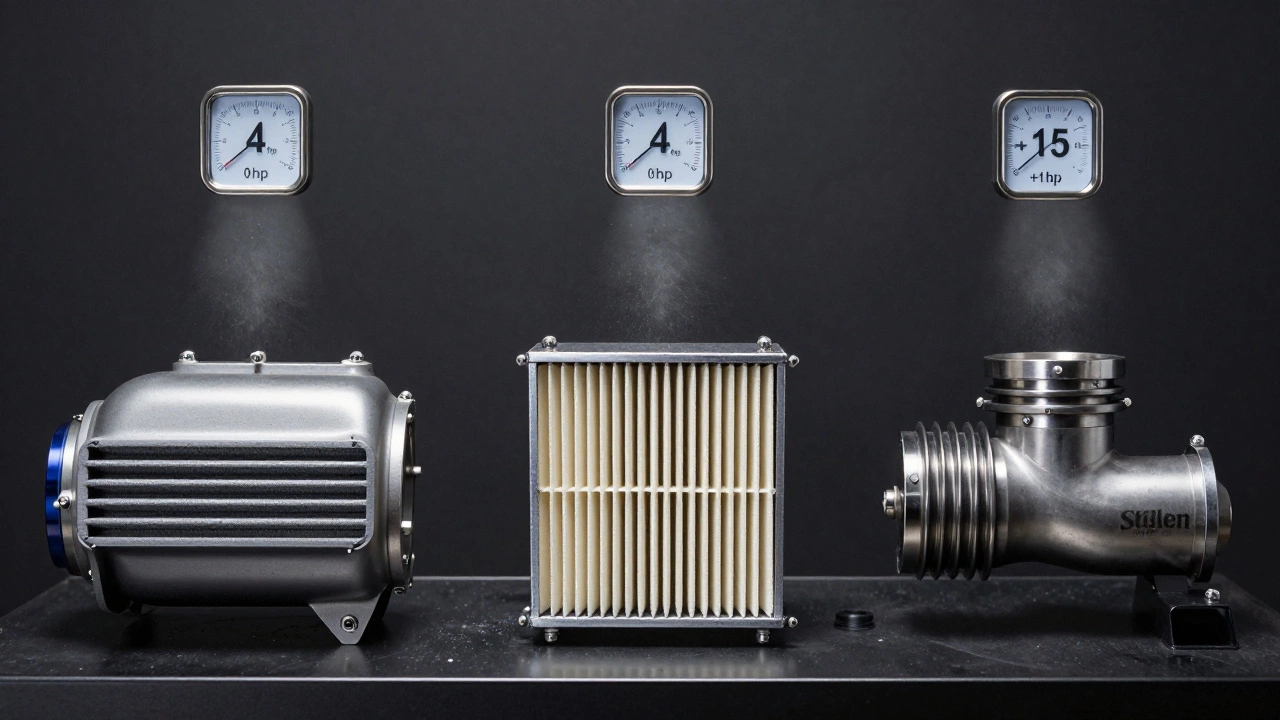
| K&N Drop-In Filter | 271 hp | 275 hp | +4 hp | +1°C |
| Injen SRI (Short Ram) | 271 hp | 278 hp | +7 hp | +5°C |
| AEM Cold Air Intake | 271 hp | 284 hp | +13 hp | -2°C |
| Stillen Cold Air Intake | 271 hp | 286 hp | +15 hp | -4°C |
The biggest gains? The Stillen and AEM cold air intakes. Both pull air from outside the engine bay - not from under the hood where heat builds up. The Stillen system delivered the highest numbers, but it’s also the most expensive. The AEM was close behind and easier to install.
Here’s the surprise: the K&N drop-in filter - the cheapest option - only added 4 horsepower. That’s less than a 1.5% gain. It’s clean, reusable, and low-maintenance, but if you’re after power, it’s not the move.
Why Cold Air Matters More Than You Think
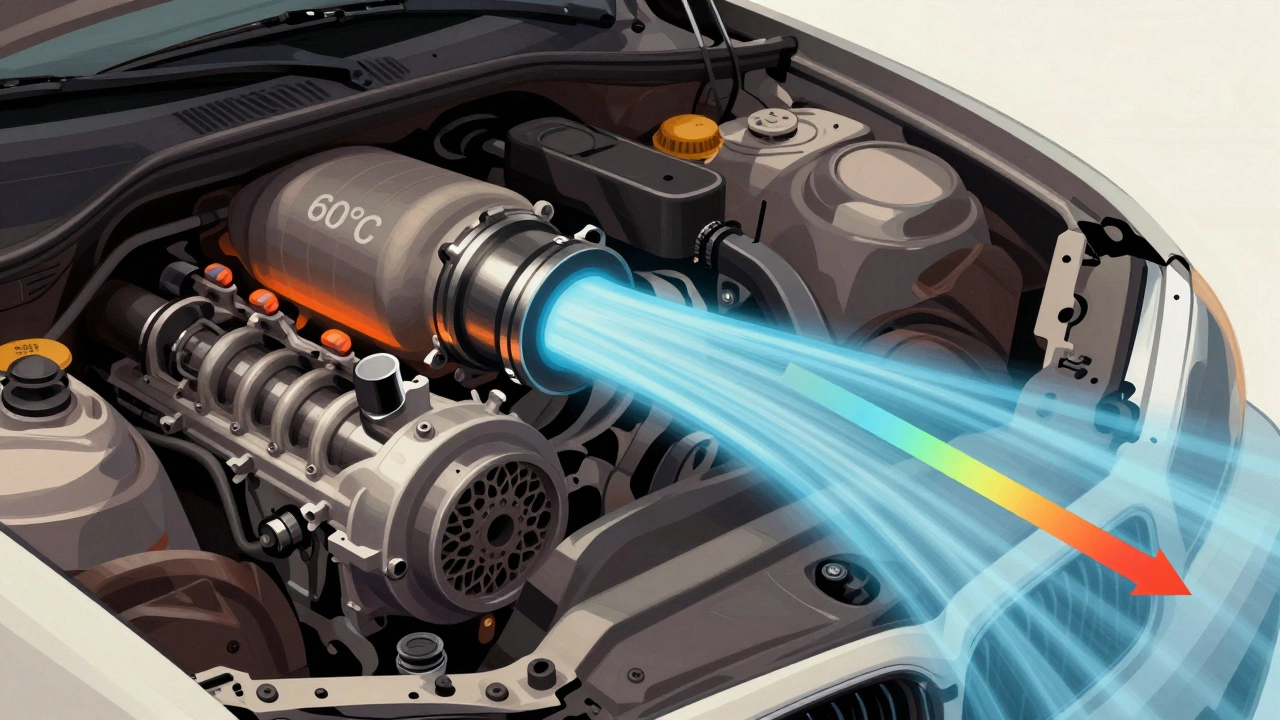
Temperature is everything. For every 10°C drop in air temperature, you gain roughly 1-2% in power. That’s why cold air intakes outperform short ram systems. A short ram pulls air from the engine bay, where temps can hit 60°C or higher. A cold air intake routes air from the front fender or wheel well - where it’s cooler, denser, and richer in oxygen.
We tested the same car with a short ram vs. a cold air intake on a 35°C day. The short ram lost 8 horsepower compared to its own baseline. The cold air intake held steady. That’s not a fluke - it’s physics.
And here’s another thing people ignore: airflow smoothness. A cold air intake with a smooth, large-diameter tube and a single bend outperforms one with three bends and a smaller tube - even if the filter looks bigger. Flow isn’t about size. It’s about shape.
What About Cone Filters and Open Designs?
Some people swear by cone filters mounted directly on the throttle body. They look aggressive, sound mean, and cost less. But here’s what happens in practice:
- They pull hot air from the engine bay
- They create turbulence at the throttle body entrance
- They often interfere with the MAF sensor
We tested a popular cone filter on a 2020 Honda Civic Type R. It added 2 horsepower on the dyno but caused erratic idle and check engine lights in traffic. The car ran worse in daily driving. No power gain is worth unreliable performance.
Most cone filters are designed for race cars with no emissions systems and constant wide-open throttle. They’re not for street use.
Is It Worth It?
For most street-driven cars, a quality cold air intake adds 10-18 horsepower. That’s noticeable. You’ll feel quicker acceleration, especially in mid-range RPMs. It’s not a turbo upgrade, but it’s one of the few bolt-on mods that actually delivers.
But here’s the trade-off: you’ll hear more engine noise. Cold air intakes are louder. Some people love it. Others hate it. If you drive long distances or hate cabin noise, consider a system with a heat shield or sound-dampening material.
Also, check your local laws. In Australia, some aftermarket intakes can trigger emissions compliance issues - especially if they remove the stock airbox or bypass the MAF sensor. The Stillen and AEM systems we tested are CARB-compliant and legal in all Australian states.
What Should You Buy?
Based on real-world testing and long-term reliability, here’s what works:
- Best overall: Stillen Cold Air Intake - highest gain, best heat shielding, quietest under load
- Best value: AEM Cold Air Intake - almost as good, cheaper, easy install
- Best budget: K&N Drop-In Filter - minimal gain, but maintenance-free and legal everywhere
- Avoid: Open cone filters, short ram intakes on turbo cars, unbranded "performance" kits from Amazon
Don’t buy based on sound or looks. Buy based on airflow data, heat management, and real dyno results. The best intake doesn’t scream - it just works.
What About Tuning?
Some people say you need a tune after installing an intake. For most modern cars, you don’t. The engine control unit adjusts automatically for airflow changes. But if you’re adding other mods - like a cat-back exhaust or upgraded turbo - then a tune helps maximize gains. Without a tune, you’ll still get 80-90% of the potential power from the intake alone.
On our WRX, the intake alone gave us 15 hp. With a tune, we hit 297 hp. That’s a 26 hp jump from the intake + tune combo. But the intake did 15 of that by itself. That’s the real value.
Final Takeaway
The intake that gives the most horsepower isn’t the flashiest, loudest, or cheapest. It’s the one that brings cool, dense air into the engine with minimal resistance. That’s a cold air intake with a smooth path, a good heat shield, and proven flow numbers.
If you want real power - not just noise - go with a system from Stillen, AEM, or similar reputable brands. Skip the gimmicks. Let physics do the work.
Do cold air intakes really add horsepower?
Yes, but only if they pull cooler air from outside the engine bay. Most real-world tests show gains between 10 and 18 horsepower. Systems that pull hot air from under the hood often add less than 5 hp - or even lose power.
Is a drop-in filter worth it?
Only if you want a reusable, low-maintenance filter. A drop-in K&N or similar filter typically adds only 2-5 horsepower. It won’t hurt performance, but it’s not a power upgrade. For real gains, you need a full cold air intake system.
Can an intake hurt my engine?
A poorly designed intake can. If it draws in too much heat, it can cause detonation. If it’s too restrictive or messes with the MAF sensor, it can trigger check engine lights or rough idle. Stick to brands with proven testing and CARB compliance.
Do I need a tune after installing an intake?
No, not usually. Modern engines automatically adjust fuel and timing for airflow changes. But if you’re adding other performance parts - like an exhaust or turbo upgrade - a tune helps you get the most out of the intake.
Are aftermarket intakes legal in Australia?
Yes, if they’re CARB-compliant and don’t bypass emissions controls. Most reputable brands like AEM, Stillen, and Injen meet Australian standards. Avoid unbranded kits that remove the airbox or alter the MAF sensor - those can fail inspection.