Headlight Compliance Checker
Check Your Headlight Setup
Results & Recommendations
Recommended Actions
If you’ve ever swapped out your old halogen headlights for bright, white LED bulbs, only to get pulled over or told they’re illegal, you’re not alone. Many drivers think LED headlights are just an upgrade-brighter, longer-lasting, more modern. But in the US, most aftermarket LED conversions are against the law. Not because LEDs are dangerous, but because of how they’re installed and whether they meet federal standards.
It’s Not the LED, It’s the Installation
LED technology itself isn’t banned. In fact, factory-installed LED headlights have been legal in the US since the early 2010s. Cars like the Tesla Model S, BMW 5 Series, and Audi A6 came with factory LEDs that passed strict Department of Transportation (DOT) and Society of Automotive Engineers (SAE) tests. These systems are designed as complete units-the lens, reflector, housing, and bulb all work together to control light output and prevent glare.
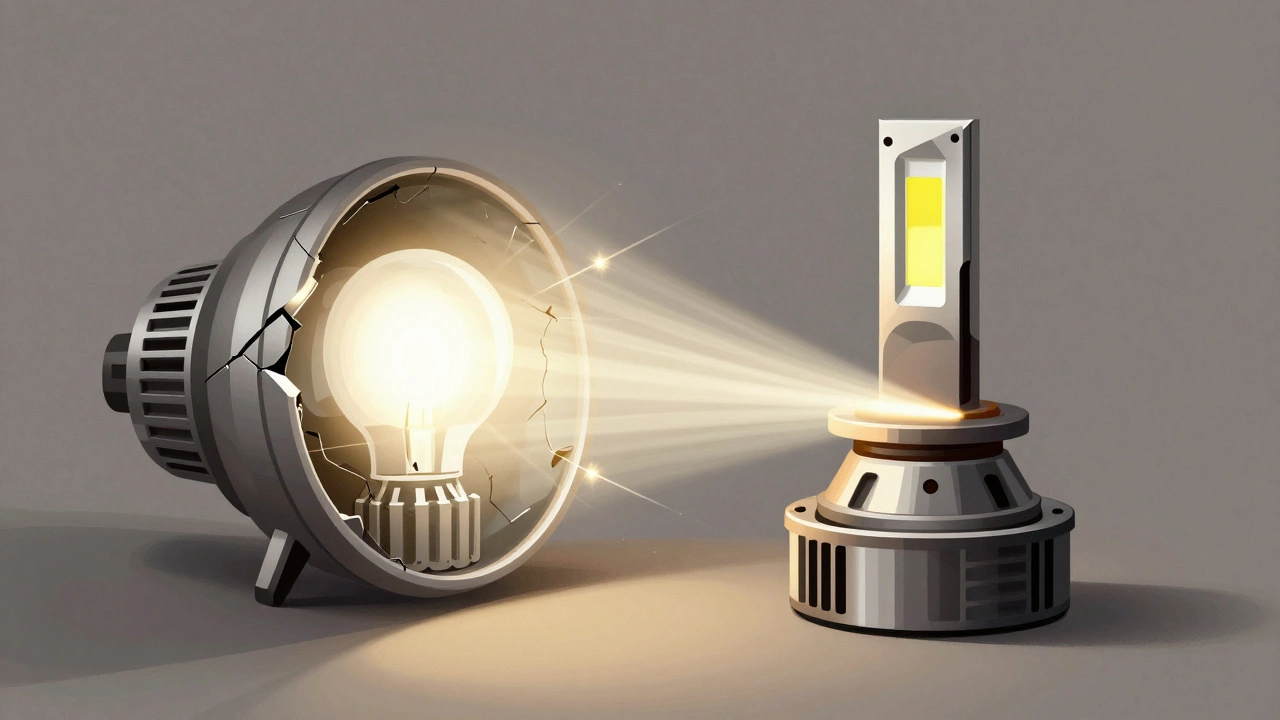
The problem comes when you take a halogen headlight housing-built for a bulb that spreads light in a wide, soft pattern-and shove in a bright LED bulb that wasn’t meant for it. LEDs emit light in a single direction, unlike halogens that glow in all directions. Without the right reflector and lens to shape that beam, LEDs scatter light everywhere: into the eyes of oncoming drivers, onto road signs, even into the windows of houses. That’s why you see so many drivers with blinding aftermarket LEDs-they’re not just bright, they’re uncontrolled.
Federal Standards: FMVSS 108 Explained
The legal standard for headlights in the US is Federal Motor Vehicle Safety Standard No. 108 (FMVSS 108). This rule doesn’t say “no LEDs.” It says headlights must meet specific photometric requirements: maximum brightness, beam pattern, cutoff line, and color temperature. Factory LEDs pass because they’re engineered as a single system. Aftermarket LED bulbs? Almost never.
Take color temperature. FMVSS 108 limits headlight color to between 3,000K and 6,000K. That’s warm white to cool white. Many aftermarket LEDs are 8,000K or higher-bluish-purple, almost neon. That’s not just distracting; it’s illegal. And it’s not about style-it’s about visibility. Blue light scatters more in fog and rain, reducing your own sight distance.
Then there’s the beam pattern. Halogen housings are designed to cast a wide, even spread with a sharp horizontal cutoff at the top to avoid shining into oncoming traffic. LED bulbs don’t match that shape. They create hot spots, dark zones, and glare that can blind drivers up to 500 feet away. The National Highway Traffic Safety Administration (NHTSA) has received hundreds of complaints about this exact issue since 2018.
Why Do People Still Buy Them?
Because the market is full of misleading labels. You’ll see boxes that say “DOT approved” or “street legal.” Those are lies. The DOT doesn’t certify individual bulbs. It certifies complete headlight assemblies. A company can slap a fake DOT stamp on a bulb and sell it online, but that doesn’t make it legal. In fact, the NHTSA has issued multiple recalls and warnings against these products since 2020.
Some sellers even claim the bulbs are “for off-road use only.” That’s a loophole people exploit. But if you’re driving on public roads with them, you’re breaking the law-even if the box says otherwise. And if you get pulled over, the officer doesn’t care about your “off-road” sticker. They see a glaring, unapproved light and they’ll issue a citation.
There’s also the myth that “everyone does it, so it must be fine.” But traffic laws aren’t based on popularity. In states like California, New York, and Texas, police actively ticket drivers with aftermarket LEDs. Fines range from $100 to $500, and in some cases, you’ll be ordered to remove them before your vehicle passes inspection.
What About OEM LED Headlights? Are They Legal?
Yes. Factory-installed LED headlights are legal because they’re designed and tested as a complete unit. The housing, lens, reflector, and bulb are engineered together to meet FMVSS 108. They have precise beam patterns, proper heat dissipation, and correct color output. You can’t just swap a bulb into one of those-it’s sealed. That’s why you don’t see people upgrading factory LEDs. It’s not designed for that.
Some newer cars even come with adaptive LED headlights that adjust the beam based on steering angle, speed, and oncoming traffic. These systems use sensors and motors to dip the beam when another car approaches. That’s the future. But again-it’s built into the car from the factory. Not bolted on after.
What Are Your Legal Options?
If you want better lighting without breaking the law, you have three real options:
- Replace the entire headlight assembly with a DOT-approved LED unit. Brands like Philips, Sylvania, and Hella make complete LED headlight kits designed to replace factory halogen housings. These cost $300-$800 per pair, but they’re certified and legal. You won’t get pulled over.
- Upgrade to high-performance halogen bulbs. Brands like Osram Night Breaker or Philips X-tremeVision give you 50-100% more light than standard halogens, without changing the housing. They’re legal, affordable ($30-$60 per pair), and easy to install.
- Wait for LED retrofit kits that are actually certified. A few companies, like Diode Dynamics and Beamtech, now offer LED kits that include housings and projectors designed to mimic OEM performance. These are rare, expensive, and require professional installation-but they’re the only aftermarket option that’s truly legal.
Anything else? Stick with halogens. It’s not glamorous, but it’s safe and legal.
Why Doesn’t the Government Just Ban Them?
It’s not that easy. The US doesn’t have a national police force. Enforcement falls to state and local officers. Many don’t know the law well enough to cite drivers for LED bulbs. Some states don’t even test for it during inspections. That creates a gray zone where people think they’re safe.
But the NHTSA is pushing for change. In 2023, they released a report showing a 22% increase in headlight-related crashes during nighttime conditions in states with high aftermarket LED use. That’s why more states are adding headlight inspections to their annual safety checks. If you’re planning to move or register a car soon, check your state’s rules. You might get caught.
What Happens If You Get Caught?
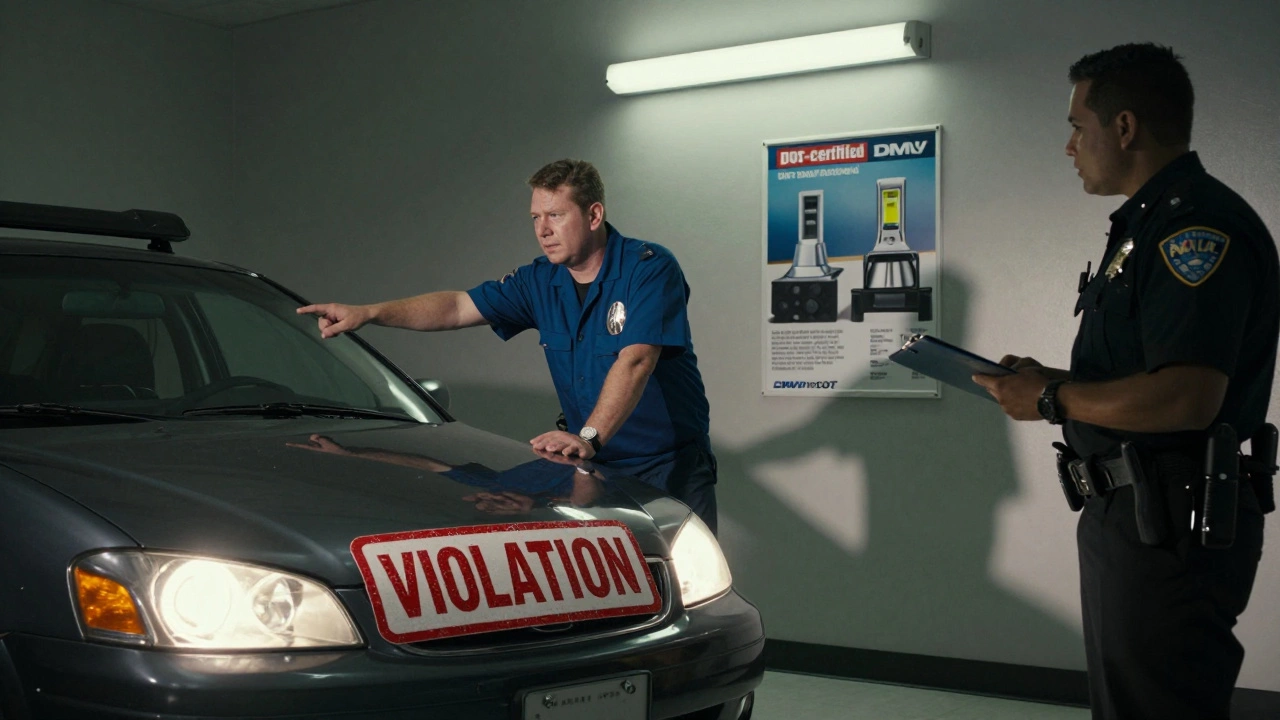
You’ll likely get a “fix-it” ticket. That means you have 30 days to remove the illegal bulbs and get the officer to sign off on it. If you don’t, the ticket turns into a fine-usually $150-$300. In some states like Massachusetts and Oregon, you can even have your vehicle impounded if the lights are deemed a “safety hazard.”
Insurance companies are also watching. If you’re in an accident and they find illegal headlights, they might deny your claim or raise your rates. It’s not guaranteed, but it’s happened. In 2022, a claim in Florida was denied after the insurer found aftermarket LEDs installed without certification.
Bottom Line: It’s Not About the Light, It’s About the System
LEDs aren’t the enemy. They’re a better technology. But putting them into the wrong housing is like putting a Ferrari engine into a bicycle-it doesn’t work, and it’s dangerous. The US law isn’t anti-LED. It’s pro-safety. If you want the benefits of LED lighting, invest in a certified system. Don’t gamble with your visibility, your license, or your insurance.
There’s no shortcut. If it doesn’t come from the factory or it’s not sold as a complete, certified assembly-it’s illegal. And the risk isn’t worth the brightness.
Are LED headlights illegal in all 50 states?
Not all states enforce the law equally, but federal law (FMVSS 108) applies everywhere. Aftermarket LED bulbs in halogen housings are illegal nationwide. Some states like California and New York actively ticket drivers, while others may only act if the lights cause a complaint or during inspections. But legally, they’re all violations.
Can I get my LED headlights approved by the DOT?
No. The DOT doesn’t approve individual bulbs. Only complete headlight assemblies can be certified. If a company claims their LED bulb is “DOT approved,” that’s misleading marketing. Look for the ECE or SAE stamp instead-but even those don’t override FMVSS 108 for US road use.
Why do some LED headlights look factory-installed?
Some high-end retrofit kits, like those from Diode Dynamics or OPT7, use custom projectors and lenses that mimic OEM beam patterns. These are expensive and require professional installation, but they’re designed to pass inspection. They’re the exception-not the rule.
Are LED fog lights legal?
Yes, if they’re installed correctly and meet FMVSS 108 standards for fog lights. Most aftermarket LED fog lights are legal because they’re designed for low, wide beams that don’t blind oncoming traffic. But if they’re too bright, too blue, or mounted too high, they can still be illegal.
What’s the difference between LED and halogen headlight performance?
Factory LED systems are 30-50% brighter than halogens and last twice as long. But aftermarket LED bulbs in halogen housings often perform worse-they create glare, uneven coverage, and dark spots. A good halogen upgrade like Philips X-tremeVision can outperform cheap LED bulbs in real-world visibility.