Suspension Damage Risk Estimator
Use this tool to estimate how lowering springs might affect your vehicle's long-term health. Adjust the inputs below to see your personalized risk profile.
Risk Assessment
Analysis Summary
Enter values above to see analysis.
Recommendation
Waiting for calculation...
You’ve seen the photos. The aggressive stance, the wheels tucked perfectly into the arches, the look of a factory performance model that cost three times as much. It’s tempting to just swap in a set of lowering springs and call it a day. But here is the uncomfortable truth: your stock suspension wasn’t designed to be lowered. When you compress those factory shock absorbers beyond their intended travel range, you aren’t just changing how the car looks; you are fundamentally altering its mechanical behavior.
The short answer to "will they damage your suspension?" is yes, but not necessarily immediately or catastrophically. Think of it less like breaking a part and more like accelerating wear on components that were already working hard. If you drive gently and choose high-quality springs, you might get away with it for years. But if you push the limits, hit potholes at speed, or ignore the geometry changes, you will pay for it-either in comfort, handling, or repair bills.
How Lowering Springs Actually Work
To understand the damage potential, you need to know what these parts actually do. Unlike coilovers, which replace both the spring and the damper (shock absorber) as a single unit, lowering springs are exactly what they sound like: shorter springs with a higher spring rate (stiffness).
Your car’s original setup balances two things: spring compression (how much the wheel moves up when hitting a bump) and droop (how much the wheel can extend downward). By cutting the spring length, you reduce both. This means the wheel has less room to move before it hits the bump stop or extends fully. The result is a stiffer ride because the spring is pre-compressed, meaning it takes more force to move the suspension through its remaining travel.
The Hidden Wear Factors
It’s not just the spring itself that suffers. The real damage happens to the surrounding components. Here is where the rubber meets the road-or rather, where it doesn’t.
- Shock Absorber Burnout: Factory shocks are valved for stock spring rates. When you install stiffer lowering springs, the shock has to work harder to control the faster oscillation of the wheel. Over time, the internal seals and valves degrade faster, leading to a bouncy, uncontrolled ride long before the shock physically leaks oil.
- CV Joint Stress: In front-wheel-drive cars, lowering the chassis changes the angle of the constant velocity (CV) joints. These joints rely on specific angles to transfer power smoothly. If the angle becomes too acute, especially during full lock steering or over bumps, the joint wears out prematurely, causing clicking noises and eventual failure.
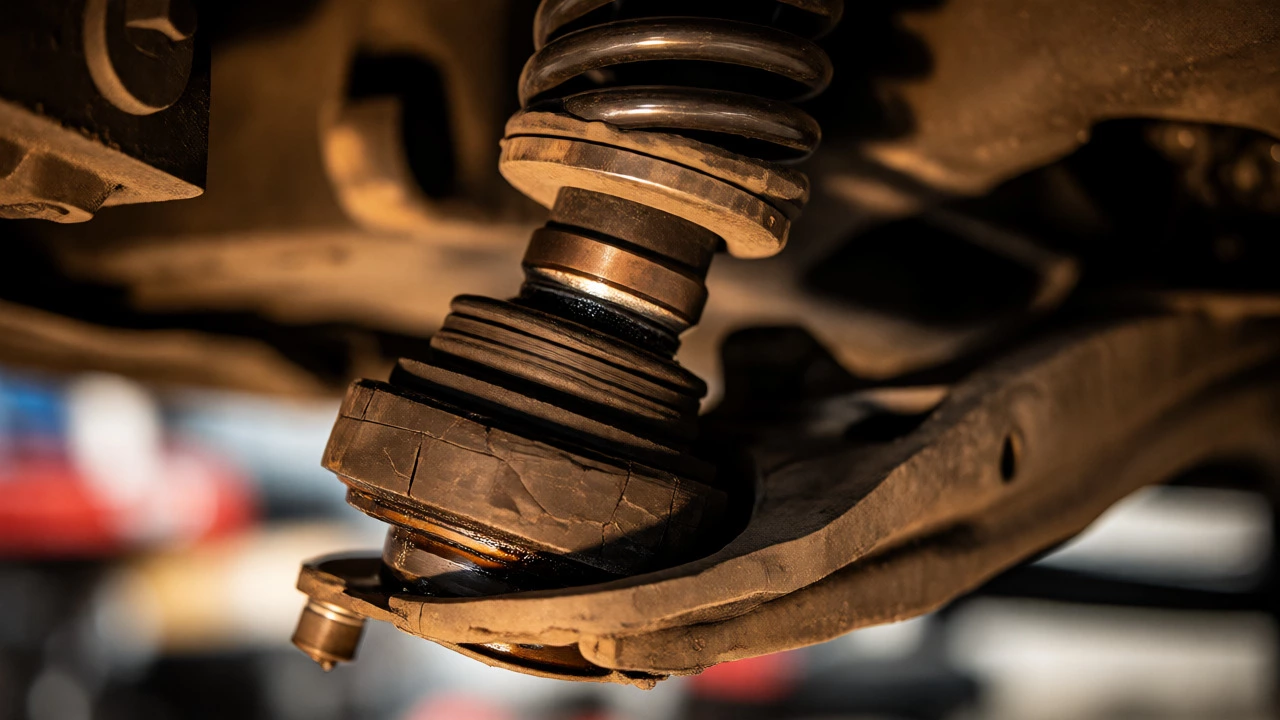
- Bushing Fatigue: Control arm bushings and subframe mounts are designed to isolate vibration within a specific range of motion. Lowering the car often twists these bushings into a permanent state of stress. You might notice increased road noise or a clunking sound from the front end as the rubber cracks and tears under constant tension.
- Ball Joint Wear: Similar to CV joints, ball joints operate best within a neutral position. Dropping the car forces them into an extreme angle, increasing friction and heat, which accelerates wear on the grease and metal surfaces.
Handling Trade-offs: Comfort vs. Grip
People buy lowering springs for better handling, and they do get some benefits. A lower center of gravity reduces body roll in corners, making the car feel more planted. However, this comes with significant caveats that many reviews gloss over.
| Feature | Stock Suspension | Lowering Springs |
|---|---|---|
| Ride Comfort | High - absorbs bumps effectively | Low - transmits sharp impacts to cabin |
| Body Roll | Moderate - noticeable in fast turns | Reduced - flatter cornering profile |
| Traction | Consistent - optimized tire contact patch | Variable - depends on alignment correction |
| Component Life | Long - designed for factory specs | Shortened - accelerated wear on shocks/joints |
| Cost | N/A (Included) | $300-$800 AUD (Springs only) |
The biggest issue is traction. While the car feels more responsive, the reduced suspension travel means the tires lose contact with the road surface more easily over uneven pavement. On a smooth track, this is great. On Adelaide’s mixed urban roads, with their tram tracks and occasional potholes, it can make the car twitchy and unpredictable.
Alignment Is Not Optional
If you skip the wheel alignment after installing lowering springs, you are asking for trouble. Lowering a car naturally causes negative camber (the top of the tire tilts inward). While a little negative camber helps cornering, too much causes rapid inner-edge tire wear. You’ll find yourself buying new tires every 15,000 kilometers instead of 40,000.
More importantly, poor alignment affects steering response. Without adjusting the toe and camber settings to match the new ride height, the car may pull to one side or feel vague on center. Always budget for a four-wheel alignment. It’s non-negotiable if you want the modification to last.
When Should You Choose Coilovers Instead?
If you’re worried about damaging your suspension, consider coilovers. They allow you to adjust ride height independently of spring rate. You can run softer springs for comfort while keeping the car low, or stiffen them up for track days. Crucially, coilovers come with matched dampers, so the shock absorbers are designed to handle the specific spring rate and travel limits of the system.
Here is a quick decision guide:
- Choose Lowering Springs if: You want a modest drop (25-40mm), have a limited budget, and mostly drive on good roads. Accept that you’ll likely replace shocks sooner than usual.
- Choose Coilovers if: You want adjustable height, better long-term component health, and plan to tune the setup for different driving conditions. Expect to pay 2-3x more upfront.
- Stick with Stock if: You prioritize daily comfort, live in an area with rough roads, or plan to sell the car soon. Modifications rarely add resale value unless done professionally.

Legal and Insurance Considerations in Australia
In South Australia, modifying your suspension affects compliance with vehicle standards. Generally, you cannot lower a car below the minimum ground clearance specified by the manufacturer or local regulations without engineering certification. For most modern cars, dropping more than 50mm might require inspection.
Also, tell your insurer. If you don’t declare the modification and crash due to a suspension failure, they could deny your claim. It’s a small admin task that saves massive headaches later.
FAQs About Lowering Springs
Do lowering springs ruin shocks immediately?
No, they don't break them instantly. However, they significantly shorten the lifespan of factory shocks. Because the springs are stiffer and have less travel, the shocks must work harder to control wheel movement. Most drivers notice degraded damping performance within 20,000 to 30,000 kilometers after installation.
Is it safe to drive with lowering springs?
Yes, provided they are installed correctly and the car is aligned. The main safety risks come from bottoming out over large bumps, which can damage the bumper or exhaust, and reduced tire contact patch on rough roads, which can affect braking distances slightly.
Can I put lowering springs on my all-wheel-drive car?
You can, but proceed with caution. All-wheel-drive systems are sensitive to changes in driveline angles. Lowering the car can cause excessive wear on the rear differential and driveshaft couplings. Many manufacturers recommend staying within a 30mm drop for AWD vehicles to avoid costly repairs.
Why does my car bounce after installing lowering springs?
This usually indicates mismatched dampers. Your stock shocks are too soft for the new stiffer springs, so they can't control the rebound quickly enough. The solution is either to upgrade to performance shocks designed for lowering springs or to switch to a full coilover kit.
Do lowering springs void my warranty?
They can void the warranty on suspension-related components. If your car is still under factory warranty, the dealer may refuse claims for shocks, struts, or control arms if they determine the modification contributed to the failure. Check your specific policy, as rules vary by manufacturer.
Final Verdict: Worth the Risk?
Lowering springs offer a cheap way to improve aesthetics and slight handling gains, but they exact a toll on your suspension’s longevity. If you treat the car gently, keep up with alignments, and accept that you’ll replace shocks earlier, it’s a manageable trade-off. But if you demand perfect comfort and long-term reliability, investing in proper coilovers or sticking with stock is the smarter financial move. Don’t let the shiny photo fool you; mechanics know the truth behind the stance.