Lowering Springs Compatibility Calculator
Vehicle Configuration
Vehicle Type
Results will appear here after calculation
Is it OK to put lowering springs on stock shocks? That’s the question many car enthusiasts ask when they want a sleeker stance without breaking the bank. The short answer is: it can work, but only if you understand what you’re changing and why.
What are Lowering Springs?
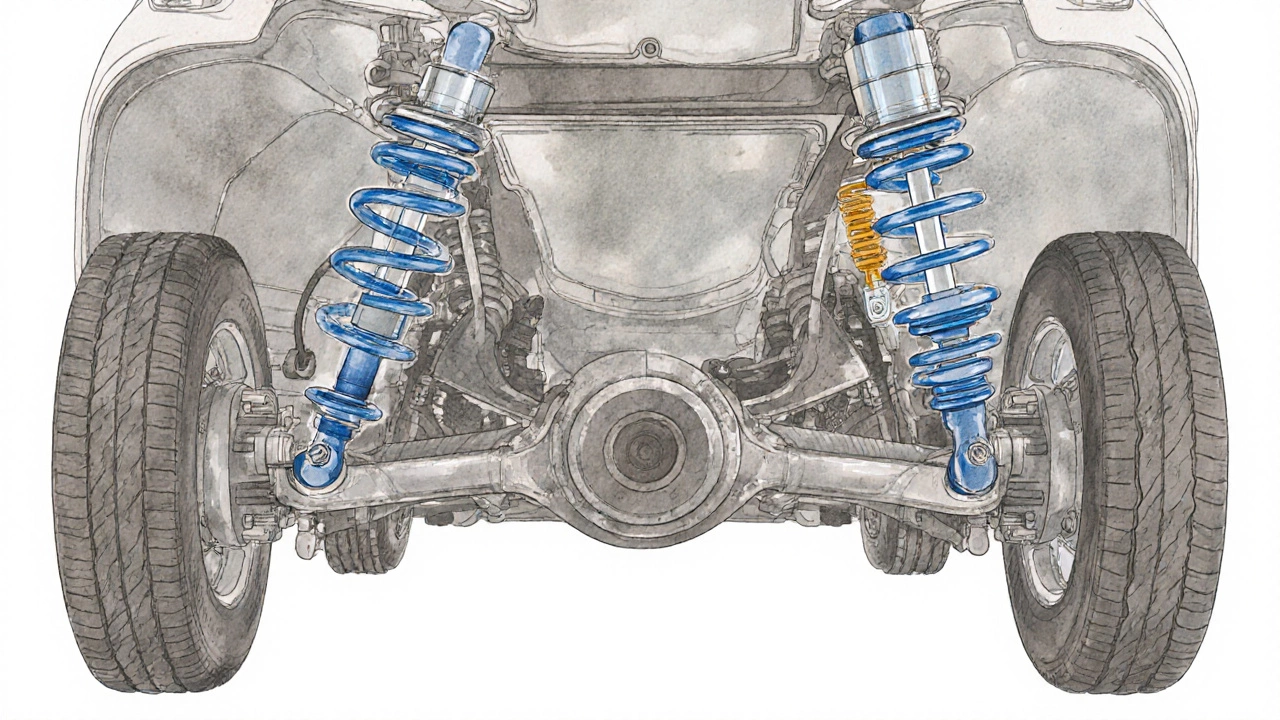
When people talk about lowering springs shorter, stiffer coil springs designed to reduce a vehicle’s ride height, they’re usually after a sportier look and sharper handling. Most aftermarket kits drop the car 1‑2 inches (25‑50 mm) and increase the spring rate by 30‑50 % compared to the factory original equipment (OE) springs.
What are Stock Shocks?
stock shocks the original shock absorbers that come installed from the factory are tuned for comfort, a wide range of road conditions, and long‑term durability. They are paired with the OE spring rates, so the overall suspension system is balanced for a neutral ride.
How Springs and Shocks Work Together
The spring’s job is to support the vehicle’s weight and absorb bumps, while the shock absorber (or damper) controls the spring’s oscillations. Think of it as a trampoline (spring) with a hand that slows the bounce (shock). If you change one side of the equation-like installing stiffer springs-without adjusting the other, the damper may struggle to keep the motion under control.
- Spring rate: measured in lbs/in or N/mm, indicates how much force is needed to compress the spring a certain distance.
- Damping force: measured in Ns/m, defines how quickly the shock slows the spring’s movement.
- Travel: total distance the suspension can move up and down before hitting a hard stop.
When you add lowering springs, the spring rate goes up and the ride height goes down, which reduces the amount of travel left for the stock shock to work with. If the shock’s damping is still set for a softer, higher‑travel setup, you’ll feel a harsher, more “bouncy” ride, and you risk bottoming out on deep bumps.
Compatibility Checklist: When Can You Pair Lowering Springs with Stock Shocks?
Before you bolt a set of lowering springs onto your car, run through this quick list.
- Drop Amount: Keep the ride‑height reduction under 1.5 inches (38 mm). Larger drops usually demand upgraded shocks.
- Spring Rate Increase: If the new springs are less than 40 % stiffer than the OEM, stock shocks are often okay.
- Vehicle Weight: Light‑weight cars (under 2,800 lb / 1,270 kg) tolerate the mismatch better than heavy trucks.
- Driving Style: Daily drivers on good roads can get away with stock shocks; aggressive track drivers need performance dampers.
- Suspension Geometry: Verify that the new ride height won’t cause the CV joints or tie‑rod ends to exceed their travel limits.
- Alignment: After a drop, you’ll need a professional corner‑balance to correct camber and toe.
If you tick most of these boxes, the combination will likely be safe and functional.
Pros of Using Lowering Springs with Stock Shocks
- Cost‑Effective: You save money by only upgrading the springs.
- Simple Installation: Most kits bolt straight onto existing mounting points, no need to replace shocks.
- Better Looks: A modest drop eliminates excess wheel gap and gives a more aggressive stance.
- Improved Handling (Within Limits): Stiffer springs reduce body roll and improve steering response on dry pavement.
Cons & Risks You Should Know
- Harsh Ride: Stock shocks are tuned for a softer spring, so you’ll notice more bumps and vibration.
- Reduced Travel: Less suspension movement can lead to bottoming out on speed bumps or potholes.
- Increased Tire Wear: Changes in camber and toe can wear the inner edges of your tires faster.
- Potential Damage to Components: Over‑compressed shocks can overload mounts, bump stops, and even the chassis.
- Unbalanced Damping: The car may feel “tight” around corners but “loose” over straight‑line bumps.
Installation Tips & Tuning Advice
Even if the pairing is technically okay, a few adjustments make a world of difference.
- Measure Ride Height: Use a tape measure from the ground to the wheel well to confirm the drop matches the spring spec.
- Check Bump Stops: Some kits include adjustable bump stops. Raise them if you notice the shock compresses fully on a small curb.
- Get a Professional Alignment: After dropping the car, the caster, camber, and toe will shift. A corner‑balance will keep tire wear even.
- Re‑bleed Shock Fluid (if possible): Some aftermarket shocks allow you to add a little more oil to increase damping. With stock shocks, you can’t, so keep an eye on ride quality.
- Listen for Noises: Clunking or squeaking after the install usually signals a binding component.

When to Upgrade the Shocks
If any of the following apply, it’s time to pair your lowering springs with performance dampers.
- Drop exceeds 1.5 inches (38 mm).
- Spring rate increase is >45 %.
- You regularly drive on twisty roads, track days, or spirited mountain passes.
- Ride quality feels uncomfortable after a few minutes.
- You've noticed frequent bottoming out on rough streets.
In these scenarios, a coilover kit or at‑least a set of **adjustable** performance shocks will give you the control you need while still enjoying the lower stance.
Comparison: Stock Shocks vs. Aftermarket Performance Shocks
| Attribute | Stock Shock | Performance Shock |
|---|---|---|
| Damping Type | Monotube, fixed valving | Mono‑ or twin‑tube, adjustable valving |
| Force Rating | ~3,500 N | ~4,200-5,000 N (depending on spring rate) |
| Travel | ~150 mm | ~130 mm (shorter, stiffer) |
| Heat Dissipation | Standard finned tube | Enhanced finning & oil reservoirs |
| Cost (per pair) | $150‑$250 | $350‑$600 |
The table shows why performance shocks pair better with lowering springs that are significantly stiffer. They can handle the higher forces, stay cool under repeated hard cornering, and let you fine‑tune rebound and compression.
Key Takeaways
- Lowering springs can be used on stock shocks if the drop is modest (≤1.5 in) and the spring rate increase is under ~40 %.
- Watch for a harsher ride, reduced travel, and increased tire wear.
- Always get a professional alignment after the drop.
- Upgrade to adjustable performance shocks when you exceed the modest‑drop limits or want track‑day confidence.
Frequently Asked Questions
Will lowering springs cause my car to bottom out?
Bottoming out occurs when the suspension reaches its mechanical limit. With stock shocks, the risk rises as you lower the car more than 1.5 in or use springs that are >45 % stiffer. Adding adjustable bump stops or switching to performance shocks reduces that risk.
Do I need to change the anti‑roll bar after a drop?
It’s not mandatory, but many tuners switch to a stiffer front sway bar to match the reduced roll caused by stiffer springs. This helps keep handling balanced without making the front end too nervous.
Can I keep my factory alignment settings?
No. Lowering changes the suspension geometry, so the factory camber and toe angles will shift. A corner‑balance alignment restores proper tire contact and prevents uneven wear.
Are there any cars that can’t use lowering springs on stock shocks?
Heavy‑duty trucks, SUVs with air‑ride systems, and cars with very soft OEM springs (e.g., luxury sedans) often exceed the safe limit. For those, you’ll need a full shock upgrade or a coil‑over kit.
Do I need to reset the vehicle’s electronic height sensors?
If your car has active ride‑height sensors (common on newer luxury models), the ECU will read the new lower height as a fault and may trigger warnings. In those cases, a proper recalibration or a compatible sensor‑block kit is required.