People often think swapping out their stock exhaust for a flashy aftermarket system will magically add 50 horsepower. You see it in ads: "Gain 40 HP with our stainless steel exhaust!" But here’s the truth - most exhaust upgrades don’t add much power at all. And if they do, it’s usually less than you think.
What exhausts actually do
An exhaust system’s main job isn’t to make your car louder or faster. It’s to get hot, toxic gases out of the engine as efficiently as possible. Stock exhausts are designed for cost, noise control, emissions compliance, and durability - not performance. That’s why they’re often narrow, full of bends, and packed with mufflers and catalytic converters that create backpressure.
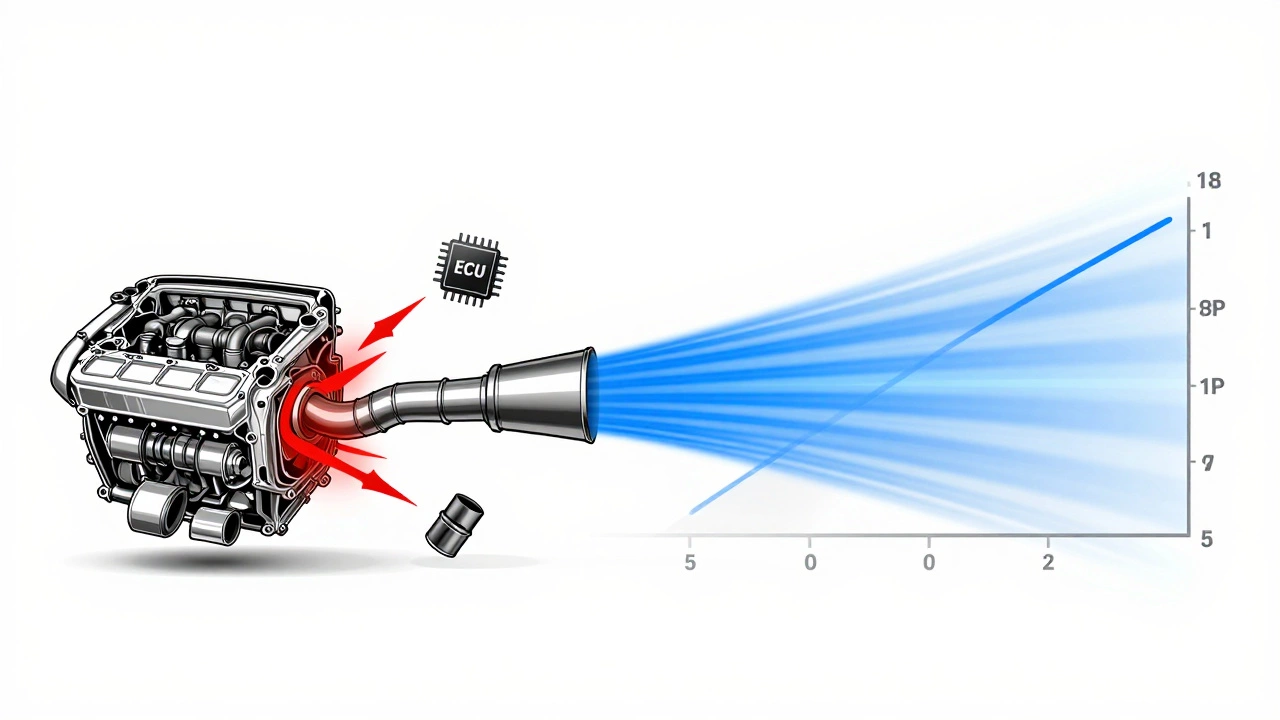
Backpressure is the resistance the engine has to fight against to push exhaust gases out. Too much of it hurts performance. A better exhaust reduces that resistance, letting the engine breathe easier. That’s where any real power gain comes from - not from the sound or the look, but from improved flow.
How much horsepower can you really gain?
On a stock, naturally aspirated car, a full exhaust system swap might give you 5 to 15 horsepower. That’s it. On a turbocharged car, you might see 15 to 30 horsepower, because turbos are more sensitive to exhaust flow. But those numbers assume you’re replacing a very restrictive stock system with a truly free-flowing one - like going from a 1.5-inch stock pipe to a 3-inch dual system with a high-flow catalytic converter.
Most people just install a cat-back exhaust - the part from the catalytic converter back. That’s mostly for sound. A cat-back alone usually adds 0 to 5 horsepower. Why? Because the real restriction is still in the headers, downpipe, and catalytic converter - parts you didn’t change.
Real gains come from full systems: headers, high-flow cats, midpipes, and mufflers designed to work together. Even then, dyno tests from sources like Car and Driver and MotorTrend show that most street cars gain under 20 horsepower from a full exhaust upgrade. That’s not nothing, but it’s not a game-changer.
Why the myth persists
Why do people believe exhausts add tons of power? Because they feel faster. When you swap in a loud exhaust, your brain thinks you’re faster. The sound tricks your senses. That rumble at 3,000 RPM feels like power - even if the engine is making the same torque as before.
Also, performance shops sell exhausts as power upgrades because that’s what sells. They know people want to feel like they’ve made a big change. A $1,200 exhaust that adds 8 horsepower looks better in marketing than a $1,200 exhaust that just sounds cool.
And let’s not forget YouTube. Videos showing a car gaining 40 HP after an exhaust swap? Those are almost always edited. The car likely had other mods - a tune, intake, intercooler - and the exhaust was just the flashiest part.
What actually moves the needle
If you want real horsepower gains, exhaust is a supporting player, not the star. Here’s what works:
- ECU tuning - Remapping your engine’s software is the single biggest power upgrade you can make. It adjusts fuel, timing, and boost. On a turbo car, it can add 30 to 70 HP without touching hardware.
- Intake system - A cold air intake can add 5 to 15 HP, especially when paired with a tune.
- Downpipe - Replacing the factory downpipe (the pipe between the turbo and catalytic converter) is often the most effective exhaust mod. It removes the biggest restriction. Gains: 20 to 40 HP on turbo cars.
- Headers - Long-tube headers improve scavenging. Gains: 10 to 25 HP, depending on engine type.
Put it all together - tune, downpipe, headers, full exhaust - and you’ll see real gains. But if you just slap on a cat-back, don’t expect miracles.
When an exhaust upgrade makes sense
Even if it doesn’t add much power, a performance exhaust can still be worth it - if you know why you’re doing it.
- You want better sound - A good system gives you a deep, smooth tone without drone. Avoid cheap systems that rattle or buzz at highway speeds.
- You’re doing other mods - If you’re upgrading your turbo or tuning your engine, a free-flowing exhaust completes the package.
- You’re replacing a rusted stock system - If your exhaust is falling apart, upgrading to a stainless steel system makes sense. You get durability and a slight flow improvement for the same price as a new stock part.
- You’re building a track car - For racing, every bit of weight and restriction matters. Lightweight titanium systems and full race exhausts are standard.
Just don’t buy an exhaust thinking it’ll turn your Camry into a Supra. It won’t.
The weight factor
Performance exhausts are often lighter than stock. A stock steel exhaust can weigh 40 to 60 pounds. A stainless steel or titanium system can cut that in half. That’s not horsepower - it’s reduced rotational mass and better handling. On a track car, that matters. On a daily driver? You’ll feel it in cornering and braking, not acceleration.
Some people forget that weight reduction is a real performance benefit. It’s not as flashy as a power number, but it’s just as real.

What to look for in a real performance exhaust
If you’re going to spend money, here’s what separates a good system from a gimmick:
- Material - Stainless steel lasts longer than aluminized steel. Titanium is lighter but expensive and not street-legal everywhere.
- Diameter - 2.5 to 3 inches is ideal for most street cars. Too big (>3.5 inches) hurts low-end torque.
- Design - Look for mandrel-bent tubing. Bends that are crushed or kinked create restrictions. Mandrel bending keeps the pipe round.
- Muffler type - Glasspacks are loud and cheap. Chambered mufflers (like Flowmaster) offer good sound without drone. Straight-through (like Borla) is quiet at cruise, loud under load.
- Brand reputation - Brands like Borla, MagnaFlow, and AWE have decades of dyno testing. Avoid no-name brands on Amazon that claim "40 HP gain" with no data.
What you’ll lose
There’s always a trade-off. A louder exhaust means:
- Noisier cabin - Even the best systems can drone at highway speeds. Test drive one before you buy.
- Warranty issues - Modifying the exhaust can void emissions warranties. In Australia, tampering with catalytic converters is illegal.
- Resale value - A loud exhaust turns off many buyers. You might have to swap it back before selling.
- Legal trouble - Many states and countries have noise limits. Some places ban straight pipes entirely. Check your local laws before installing.
In South Australia, for example, noise limits are enforced strictly. A system that sounds great on a backroad might get you a fine on the M2.
Bottom line
Exhausts don’t add horsepower the way most people think. They’re not magic. The real power comes from reducing restrictions in the right places - headers, downpipes, tuning. A cat-back exhaust is mostly for sound and style.
If you want more power, start with a tune. Then add a downpipe. Then upgrade the headers. Save the cat-back for last - because that’s the part that makes you feel like a hero, not the one that actually makes your car faster.
Choose an exhaust because you love the sound. Choose it because your old one is rusted. Choose it because you’re building a track car. But don’t choose it because you think it’ll add 50 horsepower. That’s just marketing.
Do exhausts add horsepower?
Exhausts can add a small amount of horsepower - usually 5 to 15 HP on naturally aspirated engines and 15 to 30 HP on turbocharged engines - but only if you replace the entire system, including headers and downpipe. A simple cat-back exhaust adds little to no power. Most of the perceived gain comes from sound, not actual engine output.
What exhaust upgrade gives the most horsepower?
The biggest horsepower gains come from replacing the downpipe - especially on turbocharged cars. This removes the largest restriction in the exhaust system. Combined with headers and an ECU tune, you can gain 30 to 70 HP. A cat-back exhaust alone adds less than 5 HP in most cases.
Is a cat-back exhaust worth it?
Only if you want better sound, a lighter system, or are replacing a rusted stock exhaust. It won’t give you noticeable power gains. For performance, focus on tuning, downpipes, and headers first. A cat-back is the final touch, not the starting point.
Can an exhaust system hurt performance?
Yes. An exhaust that’s too large (over 3.5 inches) can hurt low-end torque. Poorly designed systems with kinked pipes or cheap mufflers can create more backpressure than stock. And removing catalytic converters can trigger check engine lights and fail emissions tests.
Are aftermarket exhausts legal in Australia?
In Australia, removing or modifying catalytic converters is illegal under federal emissions laws. Exhaust systems must not exceed noise limits - typically 92 dB at 1.5 meters under acceleration. Many loud aftermarket systems fail these tests. Always check your state’s regulations before installing.