Wheel Spacer Impact Simulator
Adjust the slider below to see how adding a wheel spacer of a specific thickness might impact your vehicle's driving characteristics based on general automotive engineering principles.
Predicted Effects
-
Handling FeelNeutral
Negligible change; slight stability boost.
-
Ride ComfortGood
No noticeable difference.
-
Suspension WearLow
Minimal impact.
-
Risk of VibrationLow
Low risk if hub-centric and balanced.
You’ve seen them on the street. Those aggressive, flush wheels that look like they’re hugging the fender arches. Maybe you’re considering a set of wheel spacers for your own car because you want that stance, or perhaps you just can’t get your new aftermarket rims to clear the brake calipers without grinding against the strut. But there’s a nagging question in the back of your mind: will this change how my car drives?
The short answer is yes, but it’s not as simple as "it gets worse." It depends entirely on how big the spacers are, what kind of suspension you have, and whether you installed them correctly. Let’s break down exactly what happens when you push your wheels out, so you don’t end up with a wobbly mess on the highway.
What Exactly Are Wheel Spacers Doing?
Before we talk about comfort, let’s define the hardware. A wheel spacer is a simple disc, usually made of aluminum or steel, that sits between your hub and the wheel. Its job is to increase the track width-the distance between the left and right wheels-and adjust the offset (ET) of the wheel.
Think of it like holding a weight at arm’s length versus holding it close to your chest. When you add spacers, you’re moving the mass of the wheel and tire further away from the centerline of the vehicle. This changes the leverage the suspension has to control that mass. If you go too far, you’re asking your ball joints and tie rods to work harder than they were designed to.
The Impact on Steering and Handling
This is where most people notice the difference first. Adding spacers increases the scrub radius. In plain English, this means the point where the steering axis hits the ground moves relative to the center of the tire contact patch. If you’re running small spacers-say, 5mm to 10mm-you likely won’t feel a thing. The steering might even feel slightly more direct because the tires have better grip during cornering due to the wider stance.
But push past 15mm or 20mm, and things get weird. You might start feeling "torque steer" if you drive a front-wheel-drive car. This is that tugging sensation in the steering wheel when you accelerate hard. Why? Because the uneven forces through the longer half-shafts and altered geometry confuse the steering system. For rear-wheel-drive cars, the main complaint is often increased sensitivity to road imperfections. The steering wheel might jerk slightly when you hit a pothole because the lever arm on the suspension components is now longer.
Does Comfort Suffer?
Here is the part everyone worries about. Do spacers make the ride harsher? Generally, no. In fact, many enthusiasts report a smoother ride. Here’s why: by pushing the wheels out, you often reduce the likelihood of the tire sidewall rubbing against the inner fender liner or suspension components. Less rubbing means less vibration transmitted into the cabin.
However, there is a catch. If the spacers cause the wheels to sit too far out, they can pick up more road noise. Wider track width can sometimes amplify the sound of tire tread patterns, especially if you’re using aggressive all-terrain tires. Also, if the installation isn’t perfect-if the spacers aren’t hub-centric or the bolts aren’t torqued evenly-you’ll feel vibrations. These vibrations aren’t caused by the spacer itself, but by poor balance and runout issues introduced by cheap manufacturing or bad installation.
| Spacer Thickness | Handling Feel | Ride Comfort | Suspension Wear |
|---|---|---|---|
| 5mm - 10mm | Negligible change; slight stability boost | No noticeable difference | Minimal impact |
| 15mm - 20mm | Sharper turn-in; potential torque steer | Slightly firmer over bumps | Moderate increase in load |
| 25mm+ | Significant geometry changes; vague steering | Potential for increased noise/vibration | High stress on bearings/ball joints |
The Hidden Danger: Suspension Geometry
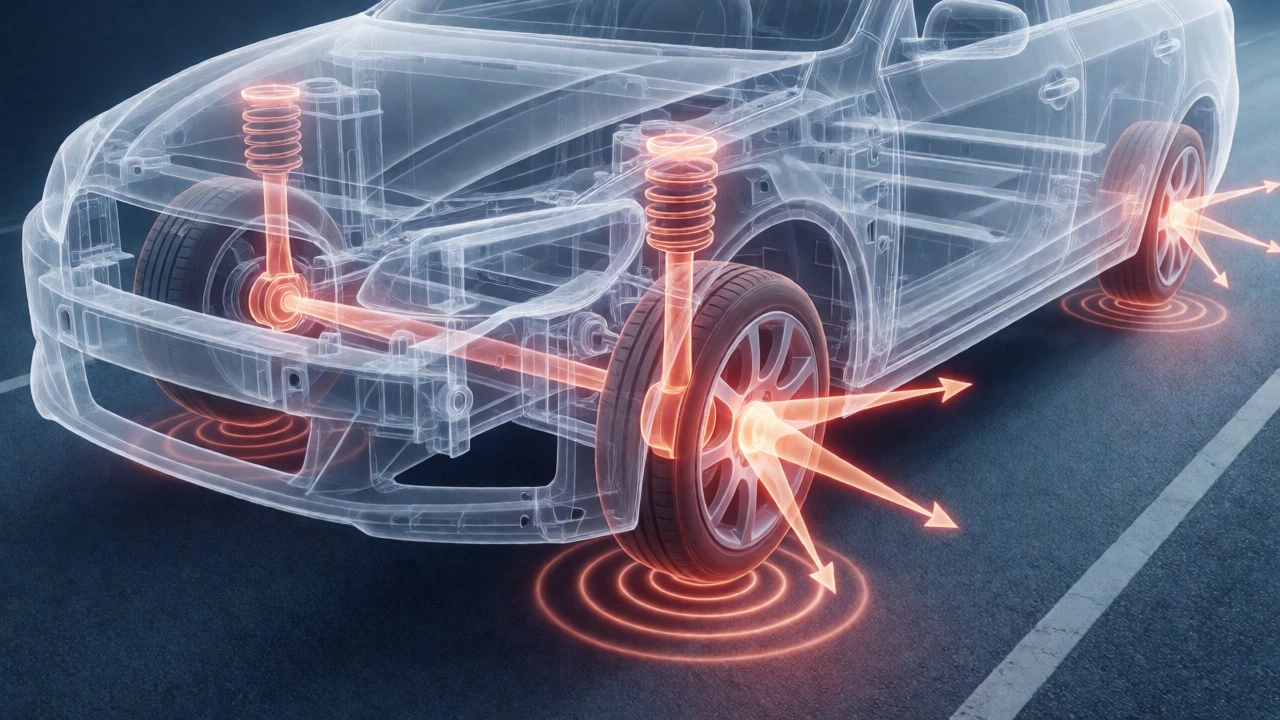
Your car’s suspension is a carefully engineered puzzle. Every angle matters. Caster, camber, and toe are set at the factory to give you predictable handling. When you add spacers, you don’t necessarily change these angles directly, but you do change the effective moment arms.
Consider your lower control arm. It pivots to allow the wheel to move up and down. When you extend the wheel outward with a spacer, you alter the path the wheel takes during compression. On independent suspensions, this can lead to negative camber gain changing unexpectedly. You might find that your inside tire lifts off the ground more aggressively during hard cornering, reducing grip rather than increasing it.
For solid axle vehicles, like some trucks or older SUVs, spacers are generally safer regarding geometry because the axle moves as a single unit. But for modern multi-link setups, you’re messing with physics. If you’re planning to go big-think 30mm or more-you really should consider adjustable control arms to correct the geometry. Otherwise, you’re driving with compromised alignment settings, which leads to uneven tire wear and unpredictable behavior.
Vibration and Balancing Issues
If you install spacers and suddenly feel a shimmy at 60 mph, don’t blame the spacer immediately. Blame the balance. Adding mass between the hub and the wheel shifts the center of gravity of the rotating assembly. Even high-quality spacers need to be perfectly balanced.
Here is a pro tip: always have your wheels re-balanced after installing spacers. Most shops will charge extra for this, but it’s non-negotiable. Cheap cast spacers often have runout errors-meaning they aren’t perfectly round or flat. This creates a wobble that feels exactly like a bent rim. If you’re buying spacers, look for forged aluminum options. They are stronger, lighter, and typically machined with tighter tolerances than cast ones.
Hub-Centric vs. Lug-Centric: Does It Matter?
This is critical for ride quality. Hub-centric spacers have a raised ring that fits precisely over the hub flange. Lug-centric spacers rely solely on the lug nuts to center the wheel.
Always choose hub-centric. If you use lug-centric spacers, any tiny imperfection in the bolt holes translates directly to wheel wobble. Over time, this causes uneven seating of the lug nuts, leading to loosening and potentially dangerous situations. Hub-centric rings ensure that the weight of the vehicle rests on the hub, not the studs. This reduces stress on the studs and keeps the wheel centered, which directly contributes to a smoother, quieter ride.
Legal and Safety Considerations in Australia
Living in Adelaide, I know how strict VicRoads and other state authorities can be about modifications. While the rules vary by state, generally, you cannot protrude beyond the fender line unless the tire is covered by a mud flap. More importantly, you must ensure that the modified track width doesn’t interfere with the operation of the brakes or suspension.
In Australia, an engineering certificate might be required if you exceed certain limits, particularly if you’re altering the suspension geometry significantly. Don’t assume a spacer is "bolt-on and forget-it." Check your local regulations. A quick call to a local automotive engineer can save you a fine and ensure your insurance remains valid.
When Should You Avoid Spacers?
Not every car needs them. If your current setup looks good and drives well, leave it alone. Spacers are a solution, not a default upgrade. Avoid them if:
- You have worn suspension bushings: Spacers increase leverage, accelerating wear on already tired rubber components.
- You drive primarily on rough roads: The added stress on ball joints can shorten their lifespan significantly.
- You are on a tight budget: Cheap spacers are a false economy. Spend the money on quality forged units or skip the mod entirely.
If you decide to proceed, start small. Try 5mm or 10mm spacers first. Drive them for a week. Notice how the car feels. If it’s still comfortable and stable, you can consider going larger next time. But remember, bigger isn’t always better. Sometimes, the best ride quality comes from the stock configuration, simply because it was tested extensively by the manufacturer.
Do wheel spacers void my warranty?
It depends on the manufacturer and the extent of the modification. Minor spacers (under 10mm) rarely void warranties, but significant changes that affect suspension geometry or cause component failure (like broken ball joints) might be contested. Always check with your dealer before installing.
Can wheel spacers cause vibrations?
Yes, but usually due to poor quality or improper installation. Non-hub-centric spacers or those with manufacturing defects (runout) can cause wobbles. Rebalancing the wheels after installation is essential to eliminate vibrations.
Are forged spacers better than cast spacers?
Generally, yes. Forged aluminum spacers are denser, stronger, and more durable than cast ones. They also tend to have better surface finishes and tighter tolerances, which improves balance and safety under high loads.
How thick of a spacer can I safely use?
For most passenger cars, staying under 15-20mm is safe without modifying suspension components. Beyond that, you risk altering geometry and putting excessive strain on bearings and ball joints. Consult a professional for sizes above 20mm.
Do spacers improve handling?
They can improve stability by widening the track, which reduces body roll. However, if the geometry becomes compromised, handling precision may suffer. The net effect depends on the specific vehicle and spacer size.