Car Detailing Business Startup Cost Calculator
Calculate Your Startup Costs
Estimate your investment for starting a car detailing business in 2026. Based on your business model and equipment choices.
Business Model
Vehicle
Equipment Selection
Additional Costs
Summary
Realistic estimate: $19,800 - $33,300 total startup costs (based on article data)
Starting a car detailing business doesn’t require a garage full of fancy tools or a million-dollar investment. But if you think you can launch it with a bucket, a sponge, and a dream, you’re setting yourself up for frustration. The real cost? It’s not just about the gear. It’s about what you need to actually make money, stay professional, and keep customers coming back. In 2026, here’s what you really need to spend - and where you can save without cutting corners.
Basic Startup Costs: What You Can’t Skip
You can’t detail a car without cleaning it. And you can’t clean it without the right tools. The core equipment you need right out of the gate includes:
- Wash system: A pressure washer (1500-2000 PSI) costs between $300 and $600. Skip the cheap ones - they break fast. A reliable one lasts years.
- Exterior detailing kit: This includes microfiber towels (at least 20), a clay bar, a dual-action polisher, and quality wax or sealant. A solid starter kit runs $400-$700. Brands like Chemical Guys or Meguiar’s are trusted by pros.
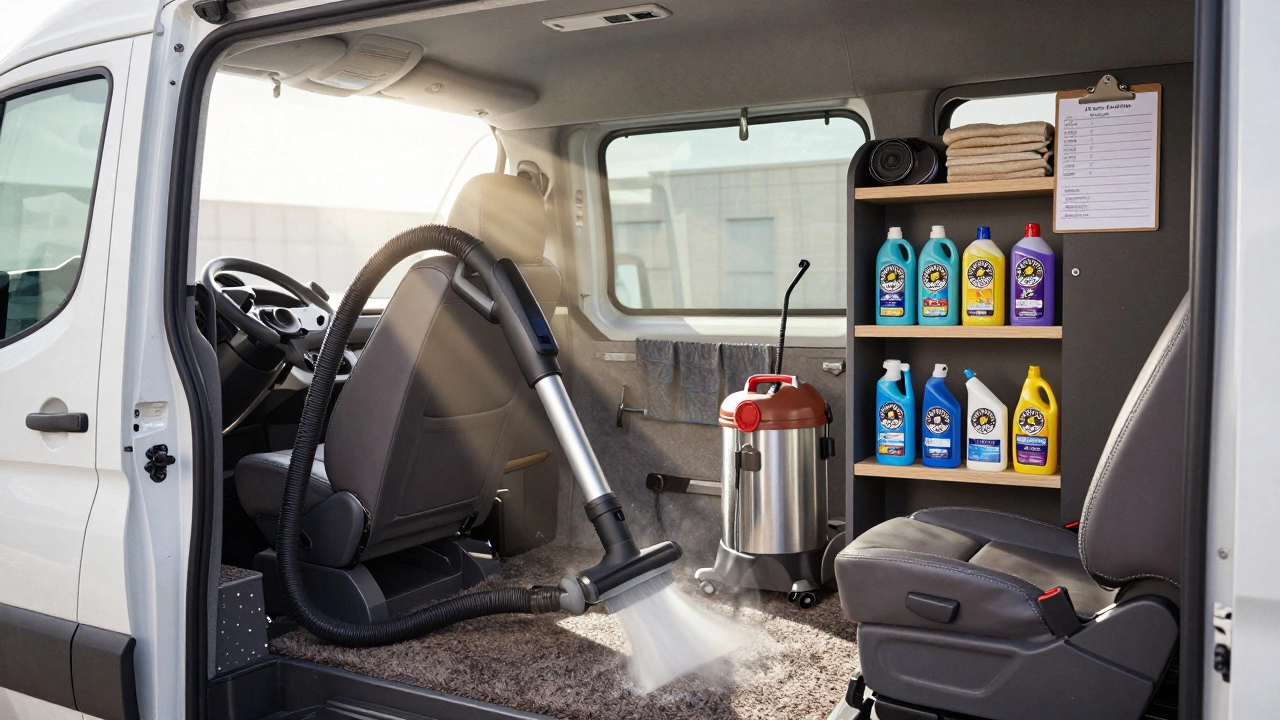
- Interior cleaning tools: A vacuum with HEPA filter ($150-$300), brush sets, leather cleaner, and upholstery steam cleaner ($200-$400). Don’t forget a good odor neutralizer - customers notice smells.
- Water source and drainage: If you’re doing mobile detailing, you’ll need a water tank (50-100L) and a portable pump. That’s another $250-$500. If you’re working from home, check local regulations - some areas ban runoff into storm drains.
That’s your baseline: $1,500-$2,500 just for tools. And this doesn’t include insurance, permits, or marketing.
Mobile vs. Fixed Location: Where You Spend More
Most new detailers start mobile. It’s cheaper, flexible, and lets you test the market. But mobile has hidden costs.
- Vehicle: You need a reliable van or SUV to haul gear. If you already have one, great. If not, a used 2018-2020 model with low miles will cost $15,000-$25,000. You can’t do this job in a sedan.
- Branding: Wrap your vehicle with your logo and contact info. A full wrap runs $1,200-$2,000. It’s advertising that drives on the road.
- Power source: You’ll need a generator or battery inverter to run polishers and vacuums. A 2000W inverter with lithium battery is $800-$1,200.
If you go fixed - say, a small bay in a shared auto shop - you’ll pay $800-$1,500/month rent. But you save on vehicle costs and can charge more. Fixed locations also let you add services like paint correction or ceramic coating, which bring in bigger tickets.
Permits, Insurance, and Legal Stuff
People forget this part until they get fined. In Australia, you need:
- ABN (Australian Business Number): Free to apply online.
- Business registration: $40-$50 for a sole trader setup.
- Public liability insurance: $500-$1,000/year. This covers you if you scratch a customer’s car. Don’t skip it.
- Water usage permits: Some councils require a permit if you’re using tap water or collecting runoff. Adelaide City Council, for example, has strict rules on drainage. Check with your local council - penalties can hit $5,000.
Legal stuff adds $1,000-$1,500 in the first year. It’s not optional. One bad review about a damaged car can sink your business if you’re not covered.
Marketing: Getting Your First 10 Customers
You can have the best detailing in the city, but if no one knows you exist, you’re just cleaning cars for free.
- Facebook and Instagram ads: Start with $100-$200/month. Target local neighborhoods, car clubs, and luxury apartment complexes.
- Google Business Profile: Free to set up. Get reviews fast by offering a free interior clean to your first five clients.
- Business cards and flyers: $150 for 500 high-quality prints. Leave them at gas stations, car washes, and parking lots of high-end condos.
- Referral discounts: Offer $20 off for every friend who books. Word-of-mouth is your most powerful tool.
Most detailers get their first 10 clients within 6-8 weeks if they’re consistent with marketing. Spend $500-$800 in the first three months. Anything less and you’re relying on luck.
What Most People Underestimate
Time. You think you’ll detail three cars a day. Reality? The first few months, you’ll do one or two. Cleaning a full sedan takes 4-6 hours. An SUV? 6-8. You’re not just washing - you’re vacuuming, steaming, polishing, drying, and inspecting every inch. That’s not a 9-to-5 job.
Also, consumables. Towels wear out. Wax runs out. Vacuum bags clog. You’ll go through 50-100 microfiber towels a month. A pack of 20 costs $40. That’s $240/month just on towels. Add in polish, cleaners, and sealants - another $150-$200. Monthly supply costs are $400-$500. Budget for it.
How Much Can You Make?
Let’s say you do three full-detail jobs a week at $250 each. That’s $750/week. Multiply by 4 weeks - $3,000/month. After supplies ($500), fuel ($200), insurance ($80), and ads ($150), you’re left with $2,070. That’s before taxes.
After six months, if you build a repeat client base, you can shift to premium services: ceramic coating ($800-$1,500 per car), paint correction ($600-$1,200), or interior restoration. These services have 70-80% profit margins. One high-end job can pay for your entire startup cost.
Where to Cut Costs Without Sacrificing Quality
- Buy used equipment. A lightly used dual-action polisher from a detailer who quit? $200-$300 on Facebook Marketplace. Just check the motor and pads.
- Start with one service. Focus on exterior wash and interior vacuuming. Add paint correction later.
- Use local suppliers. In Adelaide, companies like AutoPro Supplies offer bulk discounts on detailing chemicals. Don’t buy from Amazon unless it’s an emergency.
- Don’t rent a bay right away. Start mobile. Test demand. Then move to fixed if clients demand it.
Realistic Startup Budget: A Breakdown
| Item | Low Estimate | High Estimate |
|---|---|---|
| Wash system (pressure washer) | $300 | $600 |
| Exterior detailing kit | $400 | $700 |
| Interior cleaning tools | $350 | $600 |
| Water tank + pump (mobile) | $250 | $500 |
| Vehicle (used) | $15,000 | $25,000 |
| Vehicle wrap | $1,200 | $2,000 |
| Power inverter/battery | $800 | $1,200 |
| Insurance + permits | $1,000 | $1,500 |
| Marketing (first 3 months) | $500 | $800 |
| Initial supplies (towels, cleaners) | $200 | $400 |
| Total | $19,800 | $33,300 |
Most people start in the $20,000-$25,000 range. That’s not a lot compared to opening a café or a retail store. But it’s not a side hustle you fund with a credit card.
What’s the Real Payoff?
Car detailing isn’t glamorous. You’ll work in the rain, deal with stubborn bird droppings, and hear the same complaint: “I thought it was just a wash.” But the payoff is real. You own your schedule. You build trust. One client refers five others. Within two years, you’re running a team. You’re not just cleaning cars - you’re building a reputation.
And in 2026, with electric vehicles on the rise, detailing is more important than ever. EV owners care about their cars - they’re expensive, they’re personal, and they don’t have engines to hide under. They’ll pay for care. You just need the right tools, the right approach, and the guts to start.
Can I start a car detailing business with $5,000?
Yes - but only if you’re mobile, already have a reliable vehicle, and skip the fancy polishers. You’ll need a pressure washer ($300), a basic detailing kit ($400), towels and cleaners ($200), insurance ($500), and $1,000 for marketing. That’s $2,400. The rest goes to fuel and supplies. You’ll work long hours and take smaller jobs, but you can break even in 4-6 months. Don’t expect to buy a new van or hire help right away.
Do I need a license to detail cars in Australia?
No national license exists, but you need an ABN and business registration. Some councils require permits if you use water from the street or generate runoff. In Adelaide, you must ensure wastewater doesn’t enter storm drains - it’s illegal. Always check with your local council before setting up shop.
What’s the most profitable service in car detailing?
Ceramic coating and paint correction. A full ceramic coating for a sedan takes 8-12 hours and charges $800-$1,500. The product cost? Around $100. That’s 80-90% profit. Paint correction - fixing scratches and swirls - runs $600-$1,200. These services turn one-time clients into loyal customers who come back every 6-12 months.
How long does it take to break even?
If you start mobile and do 2-3 jobs a week at $250 each, you’ll cover your monthly expenses (supplies, fuel, ads) in 3-4 months. But to fully recover your startup costs - including the vehicle - it takes 12-18 months. The key is consistency. One loyal client who books every month pays for your entire year.
Should I buy a detailing kit online or from a local supplier?
Buy locally if you can. In Adelaide, suppliers like AutoPro Supplies or Detailing Australia offer better prices, faster delivery, and expert advice. Online kits are cheaper but often include low-quality towels or outdated chemicals. You’ll waste money on replacements. Local suppliers also carry products designed for Australian conditions - hard water, UV damage, road dust - which online retailers don’t always account for.