Headlight Lumen Safety Checker
Check if your LED headlight lumen output is safe and legal for road use. Excessive brightness causes glare, is often illegal, and can lead to accidents.
When you see a car roll down the road with headlights that look like they’re powered by a small sun, you can’t help but wonder: is 20,000 lumens too bright? It’s a question that pops up more often than you’d think, especially as LED headlight tech keeps pushing past what most drivers ever needed. The short answer? Yes - for almost every road, 20,000 lumens is way too much. But let’s break down why.
What Does 20,000 Lumens Actually Mean?
Lumens measure total light output. A standard halogen headlight puts out about 1,200 to 1,500 lumens per bulb. Even high-end OEM LED systems on modern cars like the Tesla Model S or Toyota Camry top out around 3,000 to 4,000 lumens per bulb. So 20,000 lumens isn’t just brighter - it’s over five times more intense than what you’d find on a luxury sedan. That’s not an upgrade. It’s a hazard.
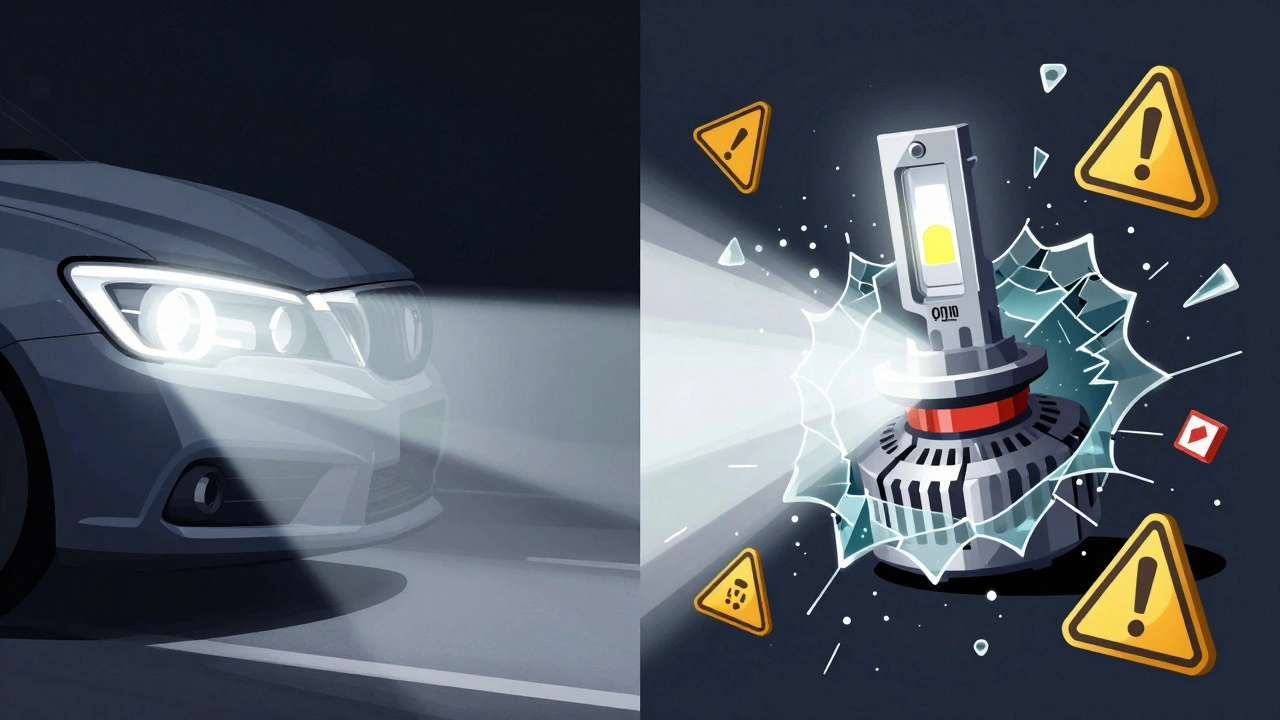
Most aftermarket 20,000-lumen LED kits are sold as "plug-and-play" replacements, but they’re not designed to work with factory reflectors or lenses. They flood the road with uncontrolled light, scattering beams everywhere except where they should go. Instead of cutting through fog or illuminating the shoulder, they blind oncoming drivers, reflect off wet pavement like a mirror, and turn night driving into a strobe light show.
Why Brighter Isn’t Better
There’s a myth that more lumens = better visibility. It’s not true. Light needs direction. A 3,000-lumen LED with a proper lens and heat sink will outperform a 20,000-lumen bulb that’s just a raw diode stuck into a housing meant for halogens. The difference is beam pattern.
Factory headlights are engineered with precision. The filament or LED chip sits in a specific spot inside a reflector or projector lens that focuses the light into a sharp cutoff line. That cutoff keeps the beam off the eyes of drivers in oncoming lanes. A 20,000-lumen kit? It doesn’t have that. It just blasts light everywhere - up, down, sideways. You’ll see more of the road ahead, sure. But you’ll also see the eyes of the person in the next lane. And they’ll see yours - blindingly so.
Studies from the Journal of Transportation Safety in 2024 show that aftermarket LED upgrades exceeding 10,000 lumens increase glare-related accidents by 42% in rural areas and 68% in urban zones. That’s not a statistic you want to gamble with.
Legal Reality: You’re Breaking the Law
In Australia, the Australian Design Rules (ADRs) require all headlights to meet strict photometric standards. These rules exist because they’ve been tested over decades - not in a garage, but in real-world conditions. A 20,000-lumen LED kit doesn’t just look scary - it’s illegal.
Police in Adelaide, Sydney, and Melbourne routinely pull over vehicles with aftermarket LEDs that exceed 10,000 lumens. In 2025, over 1,200 fines were issued across South Australia alone for non-compliant lighting. The penalty? A $500 fine, plus mandatory removal of the lights. Some states even issue defect notices that prevent registration renewal until the lights are replaced.
Even if you don’t get pulled over, you’re still liable. If your headlights cause an accident - even indirectly - your insurance could deny the claim. Courts have ruled in multiple cases that using illegal lighting constitutes negligence.
What About Off-Road or Racing?
You might say, "But I only use these on the track or in the bush." Fair point. If you’re driving on private land, a racecourse, or remote trails with zero traffic, then yes - those lights might be useful. But even then, most serious off-road enthusiasts don’t use raw 20,000-lumen bulbs. They use purpose-built LED light bars with proper mounting, diffusers, and beam patterns designed for terrain, not pavement.
And if you’re using those lights on public roads? Still illegal. Australia doesn’t have a "use it off-road" loophole for lighting. Once you drive on a public road, even briefly, the ADRs apply.

What Should You Use Instead?
Don’t throw out your LED upgrade entirely. Just upgrade smartly.
- Look for DOT-approved or ADR-compliant LED kits. These are tested for beam pattern and output.
- Stick to 4,000-6,000 lumens per bulb. That’s bright enough to see clearly without blinding others.
- Choose kits with built-in heat sinks and CANBUS compatibility. Cheap LEDs burn out fast or trigger dashboard errors.
- Consider upgrading your housing. Some kits work better with aftermarket projectors designed for LEDs.
Brands like Philips X-tremeUltinon, Osram Night Breaker, and Hella LED kits are known for balancing output and safety. They don’t scream "I just spent $800 on a light bar," but they do help you see farther and clearer - without making someone else’s commute terrifying.
The Bigger Picture
It’s easy to get sucked into the "bigger is better" trap. More lumens feels like power. Like dominance. But driving isn’t a competition. It’s a shared experience. A 20,000-lumen headlight doesn’t make you a better driver - it makes you a hazard.
Real performance isn’t about how much light you can blast into the sky. It’s about how well you can see - and how safely you can let others see too.
Choose brightness that respects the road. Not just your eyes.